In April 2026, the New York Times ran an opinion piece titled "Silicon Valley Is Bracing for a Permanent Underclass." This report takes the question that piece raised as its starting point and works through the economic structure of a world in which AI progressively substitutes for labor, reasoning one step at a time within established economic frameworks, then putting that reasoning through verification against primary sources.
At the center is a single question: does AI produce a permanent underclass? I break it into five sub-questions and take them in order. What gates AI substitution? Which jobs disappear, when, and what is born in their place? Who captures the excess profit AI generates? In that concentrated world, what can an individual (and a business) still stand on? And does the demand hold up: does AI grow the pie itself? Each of the five is developed across several parts in the body: gating in Part 1, the jobs that go and the jobs that come in Parts 2 and 8, the rent in Part 3, the footing for individuals and businesses in Parts 4, 7, and 9, and whether demand holds and the pie grows in Parts 5, 10, and 11. Part 6 is the hinge, where the evidence pulls the logic back.
Let me give the conclusion first. Followed to its end, the logic of the underconsumption tradition (Marx, Kalecki, Keynes) arrives somewhere dark: "a permanent underclass is a stable equilibrium." That is one framework's worst case, not logic as such, and the moment empirical data enters the conclusion steps down a notch. What pulls it back is measured: physical labor and cognitive autonomy are both still far from reliable. The most likely near-term shape is partial substitution punctuated by financial crises, closer to Minsky than to Marx, though that financial timing is the least certain call in this report, inferred from a fragile financing structure rather than settled numbers. The reprieve, either way, is not a wall but a clock, and that clock keeps ticking forward.
And what finally came into view is this: whether the picture is pessimistic or optimistic is not a question of fact but a question of which metric you measure by. Measured in excess profit (rent) wealth concentrates, and the picture is grim. But measured in benefit, in what people actually receive, AI puts expert-grade capability into more hands than ever before. Benefit is not the same ledger as rent, though: it pays none of the wage the displaced worker lost, and even access to it is unequal in what each person can convert it into. Where we are heading is a future split in two: access to capability more equal than ever, and the wealth and power that access converts into more concentrated than ever.
All figures are as of mid-2026 and rest on primary sources including Epoch AI, METR, the World Economic Forum, the EU AI Act, Stanford's Digital Economy Lab, and the NBER. Verification used a generative-AI research harness (roughly 100 search agents, ~25 primary sources, and a 3-vote fact-check per run) across 17 runs in total; claims that did not pass were removed from the text. One scope note up front: this analyzes the US and allied-economy equilibrium over the near to medium term, and five variables large enough to move the conclusion (a state-led China, demographic decline, the energy ceiling on compute, the unmeasured unpaid-care economy, and the historical base rate of failed underclass prophecies) are bracketed rather than resolved (see the Methodology Note).
The piece's claim runs like this. The time people have left to build assets is already short, and once AI and robots advance far enough to displace human labor wholesale, we will be frozen in our current class positions. The rich will live commanding superintelligence; everyone else will be deemed surplus and live on what welfare remains. The piece even reports the early signs of the backlash, the quiet arson, the gallows humor of engineers automating their own jobs, the boardroom anxiety.
To test this claim, I used a two-stage method. First, build the logic using established economic frameworks: the economics of tort law, industrial organization, the theory of complementary assets, the theory of effective demand. Then check the facts that logic presupposes against primary sources. This order (reason first, reconcile after) mattered. If you let AI produce the answer first, you lose the chance to calibrate your own judgment. The division of labor is: logic paints the worst-case picture, evidence tells you where the ceilings and the brakes actually are.
One qualification up front: "the logic" here is a deliberately chosen worst case, the underconsumption tradition of Marx and Kalecki. Other equally legitimate frameworks (Autor's new-task creation, Ricardian comparative advantage) start less dark, so the exercise really measures the gap between the darkest defensible model and the data, not between logic as such and reality.
As it turned out, that worst-case logic ran all the way down to a stable, frozen underclass; the evidence then pulled it back to something more like a violent business cycle. The gap between those two is the most useful thing in the whole exercise, and it is most of what this report is about.
Two principles run through the entire analysis, and I want to put them up front.
The first I call the calculability clock. AI is strong in domains where the correctness of an outcome can be checked automatically and cheaply, or where the world can be simulated. It is weak in the messy real, judgment riddled with exceptions, the manipulation of physical objects. This single principle carries much of the report's argument: it informs the speed at which cognitive labor is substituted, the limits on physical labor, and the location of the excess profit the frontier models earn. It is one of the main lenses that connect parts that otherwise look unrelated, though not the only force in play (wages, switching costs, organizational inertia, and licensing push too), and where one principle seems to explain everything it is worth watching for the places it quietly does not.
The second is Varian's principle of complements: become a complement to what is becoming cheap and ubiquitous; do not become its substitute. The more AI cheapens cognitive execution, the scarcer its complements become: trust, accountability, relationships, meaning. Pair this with Teece (1986): when the core of an innovation commoditizes, the profit flows not to the innovator but to whoever owns the scarce complementary assets around it. Together they tell you where value drains from and where it pools to.
TL;DR: What decides whether AI takes a job is not capability but whether the errors are insurable. Deployable automation = min(capability, the insurability of the residual error). Keeping a human in the loop is only transitional.
"Which jobs will AI take?" Most discussions rank jobs by how hard they are. I think that is the wrong axis. The first claim of this report is that what determines AI substitutability is not technical capability alone but whether responsibility can be borne. As an equation:
Deployable automation = min( technical capability, the insurability of the residual error )
That it is a min function is the crux. Even at 100% capability, if there is no party able to bear responsibility for the remaining errors, deployment stays at zero. Self-driving cars were "almost ready" for over a decade precisely because the right-hand term was jammed, not the driving, but the question of who eats the cost when the system is wrong one time in ten thousand. For low-stakes work (the call centers and data entry of Wave 1) the capability term is the one that binds, and substitution follows it directly; the insurability term is what governs the high-stakes professions. And the min is a simplification rather than a binary: real deployment is continuous, and the human-in-the-loop states below occupy the region between the two poles rather than violating the gate.
Reduce tort law to its economics and it appears to ask "who is at fault," but it really asks "who can bear that loss most cheaply, and is willing to" (Calabresi's "cheapest cost avoider," 1970). Deployment happens the instant a sufficiently capitalized party can price the residual error actuarially and decides to own it.
And that is exactly what happened. Waymo runs without a driver and carries the liability for its crashes itself. Mercedes's Level 3 system accepts liability while it is engaged. It was less that the technology crossed a line than that the insurance math did. This reframing matters because it tells you the binding constraint is financial and legal, not technical, and financial constraints move on their own clock.
One complication: the two terms of the min are not fully independent, because pricing a residual error actuarially first requires that the error be bounded and measurable, which is itself a technical achievement. So the gate is sequential rather than orthogonal: capability must arrive before the error can be priced. But, as the decade of "almost ready" self-driving shows, capability arriving does not make the pricing follow quickly, and the financial term can bind for years after the technical one is met. That lag is the part capability-only forecasts miss. (Appendix A treats cognitive and physical capability as gates in their own right, drivers #2 and #3, for exactly this reason.)
The speed at which a job's errors become insurable (and the human is quietly removed from the loop) is set by four things.
Table 1, The four dimensions of insurable responsibility
| Dimension | Substituted quickly | Persists longer |
|---|---|---|
| Damage per incident | Small | Large |
| Irreversibility | Reversible | Irreversible |
| Actuarial predictability | High (substituted early) | Low |
| Identifiability of the victim | Low | High |
Only the third points the other way: the more predictable, the sooner substituted. Radiology was technically automatable years ago but survived, because a missed diagnosis is irreversible and licensing restricts who may sign off. The call center had no such shield, and it fell the moment capability arrived.
There is a harsher corollary here that recurs later. The professions whose entire expertise is the pricing of risk (underwriters, actuaries, credit analysts) turn out to be among the most exposed, precisely because their domain is the most measurable, and because the firms that employ them already sit on the data needed to replace them. The cobbler's children go barefoot.
On this logic, the human-in-the-loop (HITL) arrangement is not a destination. It is a transitional state that lasts only while the actuarial data is too thin to price the error, and no longer.
And even where the human remains, much of it persists in a degraded form, what Madeleine Elish (2019) called a "moral crumple zone." The human is kept not because they catch the machine's errors but as the party to blame when there is an accident. The automation overconfidence repeatedly confirmed in aviation shows that the more accurate the system, the more humans stop verifying (Parasuraman and Riley, 1997). The power to catch the remaining 0.01% was the only reason to keep the human, and that power erodes through the very overconfidence the system's accuracy creates. The crumple zone keeps the role on the org chart while hollowing out its actual function.
Even if the structure of responsibility requires HITL, what it protects is only the existence of the job, not the level of the wage. A rubber-stamp role anyone can fill makes the labor supply effectively infinite, and the wage is competed down to the floor. What supports the wage is not the structure of responsibility but the supply restriction imposed by licensing (Kleiner and Krueger, 2013). This distinction (job-survival versus wage-survival) becomes decisive later, in the discussion of industry resilience, where several "safe" professions turn out to be safe in body and gutted in pay.
TL;DR: The speed of substitution is set by the "calculability clock" and arrives in three waves. The professions that price risk fall first; capability's arrival can briefly raise headcount (Jevons) before it falls. The market polarizes to both ends, hollowing out the middle.
The speed at which a profession's errors become actuarial is set by five factors, operating separately from technical capability.
Table 2, The five factors of the calculability clock
| Factor | Fast (substituted early) | Slow (persists longer) |
|---|---|---|
| Frequency / volume of decisions | High frequency, high volume | Rare |
| Homogeneity of cases | Homogeneous, repetitive | One-off, varied |
| Speed of outcome feedback | Right/wrong known immediately | Years later, ambiguous |
| Scale and reversibility of the worst case | Small, reversible | Catastrophic, irreversible |
| Ease of causal attribution | Separable from AI's error | Indistinguishable from noise |
"How smart the AI is" is less useful for prediction than "how fast that job's errors become actuarial." The clock, not the benchmark, is the predictor. Stated as a forward claim: a profession scoring fast on all five factors should be deployed against within a few years of capability arriving, and an all-slow one should resist even after capability is plainly present. But this is hard to falsify cleanly, better admitted than dressed up as a crisp test. Real professions vary on every factor at once (radiology is slowed by irreversibility, by licensing, and by the clock together), so almost any outcome can be rationalized after the fact by reweighting the factors. Treat the clock as a directional predictor and an organizing lens, not as a law a single clean experiment could refute.
Table 3, The three waves of substitution
| Wave | Timing | Character | Affected roles |
|---|---|---|---|
| Wave 1 | 0–2 years (under way) | Digital-only, high-frequency, low-risk, no liability problem | Call centers, data entry, routine copy, translation, junior development |
| Wave 2 | 2–4 years | Professional, but the actuarial base already exists | Financial analysts, consulting deliverables, audit, contract law, insurance underwriting |
| Wave 3 | 4 years+ | Physical, catastrophic risk, one-off | Surgery, complex diagnosis, trial advocacy, executive judgment, skilled trades |
First: the professions that calculate risk are the first to be calculated away. Underwriters, actuaries, credit assessment, risk management. These lead Wave 2, for the reason given in Part 1, their domain is the most calculable and their employers already hold the data automation needs.
Second: by Jevons's paradox, some professions actually grow right after capability arrives. In 2016 Hinton said radiologists should stop being trained: they would be replaced by AI within five years. Yet from 2016 to 2023, the number of radiologists rose. As AI cheapened reading, the volume of imaging requests exploded, and total demand (price times volume) swelled. Capability arriving does not mean immediate decline. Capability lands, induced demand lifts the numbers for a while, then the calculability clock catches up and they finally begin to fall. (The rise is measured; the fall, for radiology specifically, is still a forecast, not yet an observation.) Miss this S-curve lag and you misread how fast the clock is moving, in either direction.
The jobs that are newly born are mostly low in labor intensity. As a result the labor market polarizes toward both ends. The high-skill end (work that wields AI, work that bears responsibility, entrepreneurship) and the low-skill end (interpersonal care, the trades) survive, while the white-collar middle hollows out. And once the middle is gone, the very path from the low end up to the high end disappears with it. The same hollowing reaches inside organizations and the career ladder, as Parts 4 and 7 develop.
TL;DR: The three frontier labs hold share and revenue, but durable rent splits along the time horizon. Open weights three to ten months behind cap the price, and lock-in is weak in the data, share ≠ rent. The gate at the very top survives, but narrowed: no longer on the frontier itself, only on unrestricted use of it.
This was the most contested part of the inquiry, and it deserves the most detail.
The surge in AI software development looks at first like Jevons-induced demand. But its demand has a decisively different backing from radiology reading.
Table 4, Two kinds of Jevons
| Exogenous-demand type | Speculative-demand type | |
|---|---|---|
| Example | Radiology reading | AI software development |
| Source of demand | External willingness to pay (the sick, insurance reimbursement) | A bet on future revenue |
| Reversal risk | Low | High (evaporates if revenue never arrives) |
| Nature | Robust, one-directional | Recursive, two-directional (Soros-reflexive) |
Software development exploded because "anyone can build now," but most of those projects are unproven bets, and their fuel is venture capital plus corporate experiment budgets. In the gold-rush framing the foundation-model labs are the pickaxe sellers, and a substantial share of their revenue is therefore circular: it rests on the miners' capital, not on the miners' realized earnings. If the conviction spreads among the miners that "the gold isn't coming," pickaxe demand contracts with it. The exception is the sensitive, high-value enterprise core, where exogenous real demand puts a genuine floor under the revenue. So the pickaxe seller is partly insulated and partly exposed, a distinction that returns, sharpened, in Part 5 and Part 6.
On the surface the three labs building the most advanced models (OpenAI, Anthropic, and Google DeepMind) look like a durable oligopoly. Walk through the candidate challengers and each one falls.
Table 5, Market-structure map (threat assessment)
| Threat | Assessment | Basis |
|---|---|---|
| Independent VC-backed startups | Cannot challenge | Capital markets demand a "catch-up, moat, profit" story and cut funding. Inflection→Microsoft, Adept→Amazon, Character→Google (reverse acqui-hires) |
| Chinese models (DeepSeek, etc.) | A separate sphere | Geopolitics and data governance wall them off; Western enterprise cannot adopt the API on compliance grounds |
| OSS / sovereign (Llama, Gemma, Mistral, Nemotron) | Cannot take share | Not competitors but instruments — Meta to commoditize a complement, NVIDIA to create GPU demand, Google for mindshare, sovereigns for strategic autonomy |
| High-value work | Captured by the top 3 | The premium concentrates |
| Commodity tier | The floor caps the ceiling | OSS's short lag (≈3 months on general capability, 8–10 on agentic) holds prices down |
The crucial move here is on the open-weight row. Frontier financing has migrated from venture capital (whose return math no longer closes) to hyperscaler strategic capital and sovereign money. And that same migration leaves, outside the top three, a large pool of non-VC capital whose objective function is not "return" but "commoditize the complement" or "strategic autonomy." That is exactly the capital that funds open weights. Open weights are not trying to win the rent; they are trying to destroy it for everyone. A competitor you cannot starve of funding, because it was never seeking a return, is a different kind of force from a startup challenger. And the compliance wall around the Chinese sphere stops the API, not the weights: a walled-off market can still set the global commodity price through open releases that others re-host, which is why the open-weight floor below does not respect the same border the adoption map above does.
A natural intuition (one that came up in the analysis) is that this will settle like the telecom carriers: three majors that never start a price war, with open-weight and sovereign models playing the role of cheap MVNOs (low price, lower quality), and a stable segmentation by quality tier.
The industrial-organization mechanics behind that intuition are real. Enormous sunk fixed costs produce a natural oligopoly. A small number of players (three) supports tacit coordination by the folk theorem. Capacity constraints push the game toward Cournot competition, which (unlike Bertrand price competition) leaves a positive margin standing. So far the analogy holds.
But it rests on a hidden assumption: telecom's stable equilibrium is a capability-plateau equilibrium. "Similar quality across carriers" means capability has topped out and homogenized. If capability keeps jumping discontinuously, the equilibrium is unstable, and the tiers do not stay put.
And the MVNO half of the analogy breaks outright:
Telecom MVNO: subordinate to the incumbent's infrastructure
              (leases wholesale capacity, gets throttled at congestion)
              → segmentation is stable
Open weights: independent (self-trained, neutral cloud, cannot be throttled)
              → can raise their own quality autonomously
The right reference class for a low-price entrant that independently improves its own quality is not the MVNO but Christensen's low-end disruption, Unix → Linux, minimills in steel, Japanese cars. "Most large enterprises will choose the high-quality option" is precisely the line incumbents always deliver just before low-end disruption catches them. Two further disanalogies seal it: radio spectrum is legally scarce (a national license), whereas compute and model weights carry no legal exclusivity; and telecom never had to contend with a free substitute that improves every single year. Open weights are that substitute.
This is the hinge of the whole part. Coca-Cola defends its share against chemically identical private labels through brand and distribution, and still cannot charge a hundred times the generic price.
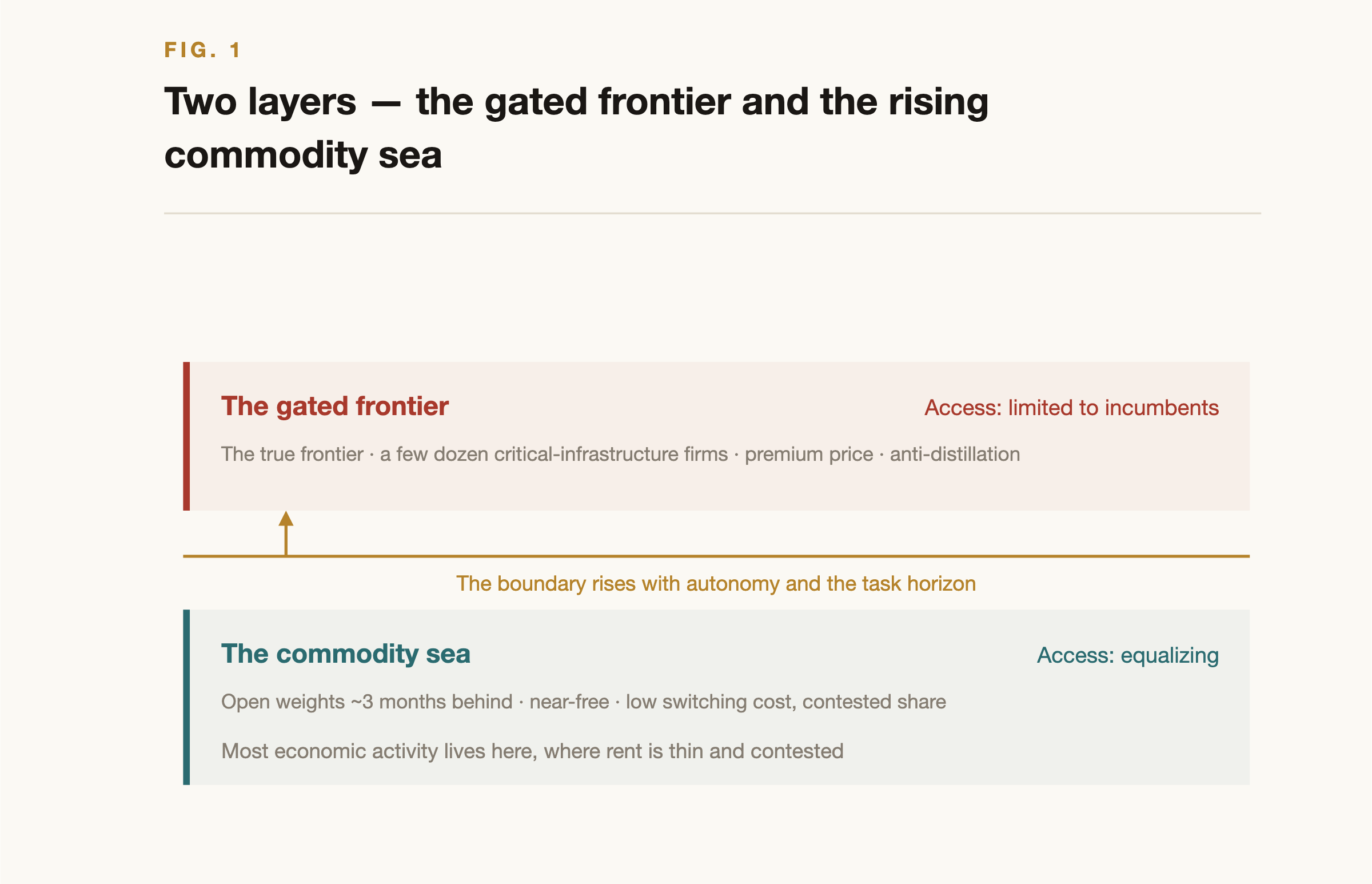
The top three can hold share (distribution, brand, switching habits) while still being unable to hold a thick margin, because on general capability the best open-weight models trail the most advanced models by only about three months (Epoch AI), sometimes closing to zero. That three-month number is the narrowest reading and it is non-monotonic (a 90% interval of roughly one to five months); on private and agentic benchmarks, which are precisely the high-value enterprise workloads where rent would otherwise sit, the gap is wider, closer to eight to ten months. Even at the wider figure the free substitute is close enough behind, and still improving, to put a hard ceiling on the price of intelligence-as-commodity: the moat is a season, not a generation. Holding share and earning durable rent are different facts, and they are entirely compatible. Share ≠ rent.
Figure 1, Two layers. Below the line, access to intelligence trends toward free; above it, the most advanced models are confined to incumbents. The boundary keeps rising.
So where does durable rent actually survive? Not between cheap work and expensive work, but inside the expensive work.
Inside a high-value agentic workload (large budget):
 · the hard planning step → frontier (high unit price) ← ~10% of tokens
 · tool calls, retrieval, summarizing, boilerplate code → cheap/floor model (low unit price) ← ~90% of tokens
The floor binds not on "cheap jobs" but on the large commodity-token fraction inside high-value jobs, and as work becomes more agentic, that fraction grows. The labs treat the commodity tier as a customer-acquisition cost, giving it away near-free, and recoup at the frontier (the Amazon commerce-plus-AWS structure). Lock-in, in this picture, is not between providers but within one, getting you to switch optimally between, say, a flagship and a small model inside the same vendor.
That framing has three consequences. First, the cross-subsidy quietly reintroduces dependence on the frontier premium: the money that subsidizes the commodity tier is the frontier margin, so if the frontier premium compresses (a scaling plateau), the cross-subsidy collapses. Second, the moat moves from "model quality" to "distribution and lock-in", which means the true competitor is the distribution platform (Google's Workspace/Android/Chrome/Search, Microsoft's Office/Windows, Apple's devices), and the incumbent integrates forward into the model layer. Third, platform lock-in has increasing returns, so the end state may tip more concentrated than telecom, closer to "one dominant plus two followers, with margins diverging" than to "three abreast."
One asymmetry keeps the two layers from collapsing into one: the price of fixed capability falls fast (per-token costs dropping ~50x a year), while the per-task cost of the moving frontier is rising as reasoning consumes more tokens (Appendix A, #5). The free-falling commodity and the expensive frontier are the same phenomenon read at the two layers, which is why "intelligence races toward free" and "the frontier premium is worth defending" are both true at once.
Here the evidence complicates the prediction. Enterprise model spending sloshes between labs: over two years one leading firm's share of enterprise spend fell from roughly 50% to about 27%, while a rival's rose from about 12% to roughly 40% (Menlo Ventures, "2025: The State of Generative AI in the Enterprise," measuring estimated enterprise LLM spend by production API usage). That is the signature of a contested, low-switching-cost market, not a captured one. The theoretical AWS-style moat exists on paper, but in the measured data share is contestable: the best model wins the quarter, and no one holds a captive customer.
One caveat runs the other way: this churn is measured in a market that is young and barely monetized, and the increasing-returns logic above says lock-in tends to harden later, as switching costs and integration depth accumulate. So the right reading is not "the moat was a myth" but "the moat has not formed yet, and still might." Today's contestability is a snapshot, not a proven steady state. This is the same story as the thin OSS moat and share≠rent, seen from the demand side.
And yet, at the very top, the opposite move is now visible. The labs have begun gating the true frontier outright. Anthropic's most capable model to date was not released broadly; through a program reported at the time as "Project Glasswing" it went to a few dozen vetted critical-infrastructure firms (the kind of firms at the center of the economy) at several times the price of the generally available tier, framed partly as a safety measure and partly, in practice, as a defense against distillation (the labs have publicly accused competitors of siphoning their models at industrial scale). So two things happen at once: ordinary intelligence races toward free while the real frontier quietly becomes members-only.
That gated access is itself a new complementary asset, and, tellingly, it is handed to precisely the incumbents who already hold capital, distribution, and data. What began as thin, single-sourced reporting has since been confirmed first-party: the lab now names the program in its own release notes. And the confirmation came with the gate's first resolution, which cuts both ways. The capability itself did not stay locked up. Within months the lab shipped its next frontier model generally, safety guardrails intact, at ordinary prices rather than a members-only premium, exactly the outcome this Part's thin-moat reading predicts. What stayed gated is the same model with the safeguards lifted, reserved for the program's vetted partners and a planned, broader trusted-access successor. So the gate proved temporary on capability and durable on permission: what is members-only is no longer the frontier itself but unrestricted use of it. A standing tier of unrestricted access reserved for incumbents is still a complementary asset in the Part 4 sense, and whether that narrower gate hardens into a permanent moat is unresolved (a caveat the Conclusion repeats where it matters). With that weight attached, the two-tier structure has moved from reported to confirmed, in a narrower form than first reported, and it sets up the inequality that Part 4 traces down to the individual. A postscript since: the state has entered as a third gatekeeper, briefly export-controlling these very models within days of their release (Appendix A).
TL;DR: What divides value is not AI access but complementary assets, Set A (structurally concentrating) versus Set B (an individual can build). Within Set B, against conventional wisdom, taste and judgment are the weakest; accountability, trust, and relationships persist. But the ladder for building them is being pulled up.
In a world where commodity AI is distributed near-free as a customer-acquisition cost, access to AI equalizes. The line that divides who captures value moves to the complementary asset you pair the AI with. What AI commoditizes is cognitive execution, which happens to be the entire foothold of the twentieth-century professional middle class. When their complementary asset (trained cognitive labor) loses its value, value flows to the assets that do not commoditize.
Applied to individuals, complementary assets split in two.
Table 6, The two sets of complementary assets
| Set | Contents | Can an individual acquire it? |
|---|---|---|
| Set A (structurally concentrating) | Capital, mass distribution, energy and compute, large proprietary datasets, privileged access to the gated frontier models | Hard |
| Set B (an individual can build over time) | Trust and track record, relationships, the standing to bear responsibility, judgment and taste, a niche audience | Yes |
Set A concentrates by its own logic, capital compounds (r > g), distribution aggregates toward winner-take-most (Ben Thompson's aggregation theory: when supply is free, demand-side aggregation is the only bottleneck), and the gated frontier (Part 3) is now an explicit Set A item handed to existing capital holders. Set B is the part an individual can accumulate through time and experience, and it shares one property: every item sits at a layer above execution: what to make, the power to vouch that something is right, whom to work with, the standing to make a decision and own its consequences. Exactly the layers AI does not touch.
Conventional advice says "climb toward upstream judgment and taste." This points the wrong way. Even within Set B, durability is decided by why the asset resists AI, and there are only two sources of resistance: a capability moat ("AI can't do this well yet", temporary, expiring as models improve; it is just further back in the same queue the calculability clock describes) and a legitimacy moat ("even if AI did this perfectly, the value still requires a human who can be trusted, held responsible, or related to", durable, because it was never a claim about capability but a social fact about who).
Table 7, The durability ranking within Set B
| Asset | Type of moat | Shelf life |
|---|---|---|
| Standing to bear responsibility | Legitimacy (accountability) | Longest |
| Relational capital | Legitimacy (reciprocity) | Long |
| Trust / track record | Legitimacy (provenance) | Core long, shell short |
| Niche distribution / personal brand | Mixed | Medium to long |
| Taste / judgment | Capability | Shortest |
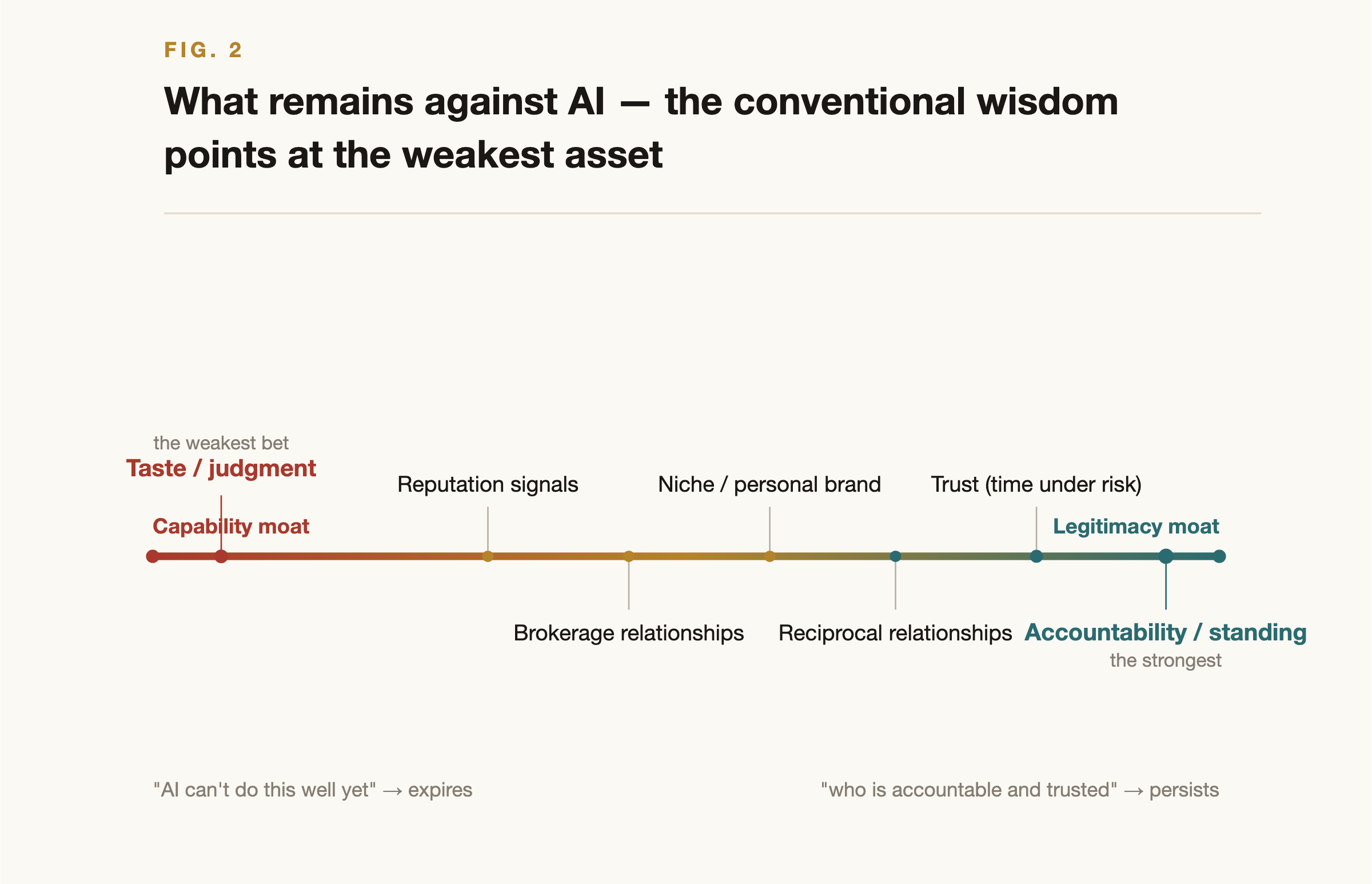
Figure 2, The durability ranking of complementary assets. The capability moats on the left (taste, judgment) expire; the legitimacy moats on the right (accountability, trust, relationships) persist.
The counterintuitive headline: taste and judgment are the weakest bet in Set B. "Discern the good thing, judge correctly" is a pure capability claim, and capability is the one thing reliably going up: it is exactly what the benchmarks measuring judgment and evaluation are now climbing. The most human-seeming asset is the one most firmly on the clock.
What persists are the unglamorous assets: the genuine standing to bear responsibility, structurally impossible for a machine that cannot be sued, fined, or shamed; the trust that can only be accumulated through time spent exposed to risk; the reciprocal relationship a machine cannot hold on your behalf. The durable move is not "out-judge the AI" (you won't) but "be the accountable, trusted human the AI cannot, legally or socially, be."
And note the recursion trap: wherever AI makes building Set B easier and faster (mass-posting your way to a personal brand), everyone can do it and it commoditizes; the durable core is precisely what AI cannot forge or shortcut.
There is even a deeper dependency. The durability of the strongest moat (the legitimacy of accountability) itself rests on a political variable: whether society grants AI legal personhood and accountability. The article's "this is basically a societal choice" reaches all the way down to how solid an individual's foothold is. A Set B strategy is simultaneously a personal strategy and a piece of policy advocacy.
Here is the cruel part, and it is the strongest form of the underclass worry. Every one of these assets can only be built by doing real work, under real risk, over real time, which is precisely the apprenticeship AI is dissolving at the bottom of the ladder.
Before: do execution → judgment develops → acquire Set B → leverage AI
After AI: AI does the execution → no experience to grow judgment → cannot acquire Set B
Juniors who lean on the tools finish their tasks without ever understanding them (Anthropic research); the rung that used to convert execution into judgment is being quietly sawn off. The most valuable assets become harder to acquire at the very moment they become most valuable. So the "last chance" anxiety people describe is not really about a window for building wealth. It is about a ladder being drawn up while they are still climbing it. Those who already held Set A and Set B before the AI era can amplify them; those starting to climb now find the rungs gone. And the cross-class solidarity the article notices (white-collar and blue-collar alike) has a precise economic basis: both groups held nothing but the cognitive-execution labor that is now commoditizing.
The old ladder bundled four functions into "execution": exposure to cases, calibration of judgment against outcomes, a graduated increase in responsibility (failing safely at small stakes while climbing), and a legitimacy signal ("paid their dues"). When AI takes execution, all four are lost at once, and rebuilding means unbundling them and re-supplying each by other means.
Exposure and calibration AI can actually accelerate, provided the human judges first and checks against AI second, or no calibration happens. Graduated responsibility is the hard one: AI offers no "small, safe failure," so it must be synthesized (shadow responsibility, where you record your judgment and reconcile it against the real outcome without acting on it; staged delegation; and the responsibility-insurance logic of Part 1, where insurance replaces "the boss catches it"). But because firms in the AI era cannot recapture training investment (Becker 1964), supplying graduated responsibility is a market failure, essentially a public good. The individual can self-build the first rung (the discipline of recording judgments and reconciling them with outcomes); the rest needs policy.
Reaching Set A, finally, runs through Set B. Entrepreneurship is the canonical device for converting Set B into Set A, turning trust, relationships, and a proprietary feedback loop into equity, a rent claim, and a customer base of one's own. The other conversion paths are joining an organization that pays in equity, becoming an investor or allocator, or being a deeply specialized independent professional. Compute can simply be rented; the genuinely scarce Set A items (mass distribution, energy) are reached, for the most part, only through a Set B → Set A conversion. Which is the real content of "the window is closing": it is a race between converting labor income into a rent claim and the rate at which the ladder is pulled up.
TL;DR: Automation that is rational for each firm destroys, in aggregate, its own market. The MPC gap makes "high GDP yet collapsing demand" possible. The labs sit downstream of that demand. "No policy" converges to a crash, a stable bipolarization, or a political rupture.
Parts 1–4 were microeconomics: who captures the rent. This part is macro: the cycle in which the final demand that pays that rent is eroded by AI's substitution of labor. It is the AI version of three old arguments: Marx's realization problem, Keynes's effective demand, Kalecki's capitalists' dilemma, and its kernel is the (possibly apocryphal but apt) Ford–Reuther exchange: "How are you going to get those robots to buy your cars?" One flag before the mechanism: the underconsumption reading these three share is a minority position in modern macro (the mainstream expects the unspent income to return as investment demand), so this Part is the report's deliberately chosen worst case. A reader who rejects that premise should expect most of its dark dynamics not to fire, and the mechanism subsection below states this load-bearing assumption explicitly rather than burying it.
What is rational for each individual firm (automate, cut costs, raise margin) destroys, in aggregate, the demand those same firms sell into. And the top three labs can be the ultimate victims of that fallacy of composition, because their product (automation) erodes their customers' customers (consumer demand).
Layer 1: labor share ↓ + unemployment → consumer income ↓
Layer 2: discretionary consumption ↓ (necessities hold up, by Engel's law)
Layer 3: revenue ↓ at the firms that serve discretionary demand
Layer 4: enterprise AI spend is derived demand → it shrinks when final demand shrinks
Layer 5: top-three revenue ↓
Enterprise AI spending exists only because companies are selling to consumers. The labs sit downstream of the very consumer demand their product is shaving away. Alex Karp put the boardroom version of it plainly: if the country comes apart, none of us make any money, the realization problem stated as a CEO's intuition.
AI does not destroy income so much as redistribute it (labor → capital, labor share down). The unemployed lose income; capital owners and AI firms gain it; aggregate income can be flat or even rise. So why does demand shrink? The gap in the marginal propensity to consume:
Worker MPC ≈ high (spends most of income)
Capital-owner MPC ≈ low (saves/invests most)
Redistribution from high-MPC to low-MPC hands ⟹ aggregate consumption falls even with aggregate income constant
Output (supply) can rise while demand for that output sags, Say's law breaking on the MPC gap. A "rich AI economy" (high GDP) and a demand collapse are perfectly compatible; that is the underconsumption core of Kalecki and Keynes.
The mechanism is contested, not settled: the mainstream reply is that the capital owners' unspent income is not idle but becomes investment demand (which funds the very capacity and productivity that cheapens goods), and that fiscal transfers and wealth effects blunt the gap further. This report leans on the underconsumption reading deliberately, as the chosen worst case of the Introduction rather than as consensus, so the MPC gap is best read as a load-bearing assumption, not a law. Beneath it sits one more parameter economists genuinely fight over: whether capital and labor are, in the aggregate, substitutes or complements. The dark reading assumes substitutes, which is exactly what AI-as-cognition makes newly plausible and earlier automation mostly was not; if they stay complements, this Part's dynamic runs backward and most of its darkness never fires.
The low-MPC money that isn't consumed flows into asset markets instead, producing the divergence we already see, an asset-price boom (AI investment reported as a large share of recent GDP growth) alongside stagnant real final demand. But asset values are claims on future consumer cash flows; if consumers can't buy, those claims get marked down. It is a reflexive bubble at the macro scale.
There is a specific reason to expect the optimistic mechanism to invert here rather than merely hold. The loanable-funds rebuttal assumes that reinvested capital income creates labor demand: a new factory hires workers. But in an AI economy the marginal investment is in compute, models, and robots, which substitute for labor rather than complement it, so recycling savings into investment accelerates the erosion of the wage bill instead of repairing it. The mechanism that is supposed to close the MPC gap is, under AI, the same mechanism that widens it. The objection writes itself: the loom and the tractor were also labor-substituting at the margin, and the mechanism still closed, because displaced workers climbed to a rung the new capital could not reach. The difference is that this investment substitutes for the rung itself, cognition, so the destination the old reallocation relied on is the thing being automated. That is what makes the underconsumption reading the right one for this case in particular, and it also names the condition that would disconfirm it: if AI investment shifted back toward labor-complementary capacity, the gap would close on its own and this Part's dark dynamics would not fire.
One genuine offset deserves its place here rather than a footnote, because it is the first objection the build-out invites: not all of the investment is labor-substituting. Data centers are built by construction crews, wired by electricians, and fed by new generation and grid capacity, and the current capex wave is producing a real hiring boom in exactly the trades Part 7 rates most resilient. But that demand is construction-phase demand. It scales with the growth of the compute stock rather than its level, so it lasts only while the build-out accelerates; it is geographically narrow; and the wage bill it creates is small next to the cognitive-labor wage bill the same compute is deployed against. It softens the dynamic locally and temporarily; it does not close the gap.
The labs' insulation is front-loaded and their exposure is back-loaded.
| Force | Direction | Phase |
|---|---|---|
| (a) Substitution force: revenue ↓ → cut costs by deploying more AI | AI spend ↑ (counter-cyclical) | early downturn |
| (b) Scale force: output shrinks → less AI needed | AI spend ↓ (pro-cyclical) | after automation completes |
Early in a downturn the labs are protected by defensive automation; once labor has been cut to the bone, the substitution force (a) saturates, and AI spend becomes a function of shrinking output (b) alone. The pivot is "peak labor displacement," and it lines up with the wave structure of Part 2 (the insurance runs dry wave by wave).
The promise of the optimists inverts here. The hopeful story is that AI drives the price of goods down far enough that even a shrunken income still buys a decent life, abundance as liberation. Read as political economy, abundance does something colder: cheap necessities make a permanently excluded class survivable, which is to say stable rather than explosive. Bread without the circuses. On this reading abundance does not free the underclass; it is the thing that could make a permanent underclass politically durable. (Baumol qualifies it: the things that don't get cheap (housing, healthcare, positional goods) become the binding constraint on real welfare, and where they threaten survival, stability gives way to rupture.)
Could the system self-correct without policy? No, because demand is a public good. If one firm props up demand on its own, it bears the full cost while the benefit scatters across all firms, and a fully automated competitor drives it out. Propping up demand alone is competitive suicide (Kalecki's capitalists' dilemma). The wage-generated aggregate demand is a positive externality no firm internalizes. The partial exception is monopoly: a near-monopolist internalizes more of the demand externality (Ford's $5 day), so any endogenous private correction points not toward broad wage recovery but toward corporate feudalism, company-town welfare that saves a firm's own workers and no one else. Amodei's musing about paying employees who no longer add value is exactly this species, and exactly this limited.
So "no policy" resolves to one of three endpoints:
| Endpoint | Mechanism | Precedent |
|---|---|---|
| (a) Involuntary crash | Asset prices correct on unrealized demand → depression → reset by capital destruction | Marx's crisis theory; reflexive-bubble collapse |
| (b) Stable bipolarization | A small formal sector (for capitalists + B2B) plus a large excluded sector — the underclass as the equilibrium, steady not transitional | The Gilded Age, the dual economy |
| (c) Political rupture | Pressure routes into force → non-economic corrective | The article's arson; Karp's "the country explodes" |
Deflationary abundance is the selector between (b) and (c): cheap bread keeps the masses alive → stable dualism; Baumol goods threaten survival → rupture. The sharpest inversion is that the promised abundance functions less as liberation than as the sedative that makes a permanent underclass politically sustainable.
I red-teamed this conclusion hard, and the most uncomfortable finding is that the most hopeful-looking objection makes it worse, not better. The objection runs: labor still gets employed, comparative advantage leaves low-value tasks to humans (because compute is finite), and the wealthy will pay for human service. True, perhaps, but that rewrites "explosive exclusion" into "stable low-wage subordination," a servant economy. The employed don't revolt, so it is more stable, and the labs' demand ceiling is slightly higher. Even the hope of self-correction-by-rupture gets eroded by the rebuttal. The only endogenous forces that actually break the dark equilibrium are a technological plateau or lag (does substitution complete?) and fiscal necessity (a collapsing tax base forcing the state to act before the grim fixed point is reached). Whether the first of those holds is an empirical question, and that is exactly where Part 6 turns.
TL;DR: The logic of the underconsumption tradition descends to a dark equilibrium, but the evidence pulls it back, and what pulls it back is measured: physical labor and cognitive autonomy are both still unreliable, and a thin moat erodes the capital chasing the frontier. The likeliest near-term shape is partial substitution punctuated by financial crises, more Minsky than Marx, though the financial-crisis timing is the report's least certain call. The reprieve is a clock, not a wall, and it keeps shrinking.
Here I stopped reasoning and met the data. The five remaining empirical uncertainties (a different five from the bracketed scope variables of the Abstract) reduce to three drivers, and feeding verified data into the dynamics changed where the system settles.
| Driver | Variables | Decides | Governs |
|---|---|---|---|
| A. Reach of substitution | Cognitive generalization beyond coding + the robotics lag | How much, how fast | Whether the dark dynamics of Parts 2 and 5 even fire |
| B. Durability of rent | The OSS lag + moving-frontier inference cost | Whether the top three keep a thick margin | Part 3 |
| C. Fundability | Capex vs revenue | Whether capital markets fund the race to the finish | The reflexive bubble |
A is upstream (does the dark dynamic fire), B is distribution (who takes the rent), C is the gate on the upstream (a bubble collapse stops the race).
Revenue is hump-shaped in substitution: early substitution (replacing high-cost labor while demand is intact) raises revenue; late substitution (eroding demand via the MPC gap) lowers it. There is a revenue-maximizing optimal substitution rate A*, beyond which the move is self-defeating. But by the fallacy of composition no single firm stops at A*, cost-cutting is a private benefit, demand destruction a shared cost, so the system overshoots A* and triggers a bust.
The result is a Minsky-type limit cycle: boom → overshoot → demand destruction dominates → revenue falls → capital markets lose patience → bust (capex collapses, assets crater, some labs fail) → partial reset (capital destruction compresses inequality a little, rebalancing the MPC, reviving some demand) → new boom. And it ratchets: the automation capability survives each bust (a function once automated stays automated even when capex stops), so substitution drifts upward cycle over cycle, the demand floor drifts down, and the crises deepen, until the A-ceiling (the limits of substitution) stops it.
A caveat the shape invites: a cycle with a boom phase, a bust phase, and a reset phase can be fitted to almost any trajectory after the fact, so its worth is as a mechanism that names the forces, not as a prediction that could be cleanly disconfirmed. What would disconfirm it is the absence of the overshoot, substitution settling at A* without a bust, and that is the empirical question the financing data (Driver C, Appendix A) will eventually answer.
One corollary reframes corporate "generosity." Redistribution moves A* outward, if you prop up demand, revenue keeps rising to a higher substitution rate, which makes a UBI funded by robots and robot-owners the industry's profit-maximizing strategy, not its charity. When AI firms talk about redistribution, that is an offensive move on the demand curve, not altruism.
Robot hardware is accelerating: the 2035 market forecast (Goldman Sachs) was revised up roughly sixfold, unit prices fall about 40% a year (faster than the assumed 15–20%), and real pilots run on factory floors. And the learning side has genuinely leapt: the newest manipulation models generalize to entire houses never seen in training, with a data-diversity scaling law (an ablation showed multi-environment data is load-bearing, success collapsing from 94% to 33% without it), and skills now transfer across different robot bodies with no retraining (cross-embodiment motion transfer between distinct platforms). World models supply synthetic training data. This is the closing mechanism made visible: Moravec's paradox is not a permanent law but a slope with a plotted descent.
And yet reliability is still poor. On the first large independent real-hardware benchmark, the best generalist policy completed just 17.7% of tasks (task-specific policies, 43.7%), and the home humanoids now shipping are still teleoperated by humans behind the scenes (autonomy on the order of 60–70%). Physical labor is protected for now, not because robots can't learn, but because they can't yet be trusted to be left alone.
"Years to decades" reads as too comfortable; for meaningful (not total) physical capability, "years, not decades" is my best guess. But it is a judgment, not a measurement, and it is the same S-curve optimism the report warns against on the cognitive side (Part 2): the data here (the data-diversity scaling law, the 94 to 33 collapse) shows that diversity drives generalization, not how many years reliability takes to climb from 17.7% to the level an unsupervised deployment needs. The direction is well-evidenced; the timeline is not.
The commodity gap is about three months and enterprise customers switch easily; if the frontier confers little lasting advantage and customers don't stay, the capital expenditure chasing it is hard to justify.
The financing is circular, a handful of giants are each other's suppliers, customers, investors, and validators, with cloud-credit investment and intertwined stakes, sitting on a duration mismatch between hardware that depreciates in about a year and debt written against a 7-to-15-year life. The leading labs are still deeply loss-making; one is reported (The Information, 2025) to burn roughly $115 billion cumulatively through 2029 before turning cash-flow positive around the end of the decade, even as its private valuation roughly doubles every few months. None of it is audited, because these are private companies and the real margins stay behind the curtain, which is exactly why the coming run of IPOs is the keystone. That run has now started: the two leading labs filed for IPOs, confidentially, within a week of each other in June 2026. Confidential filings disclose nothing yet, so the keystone event is still ahead; what changed is that it now has an approaching date rather than a hypothetical one.
An S-1 is the first document that drags the true unit economics and the circular deals into daylight. If the economics are sound and the lock-in is real, that disclosure steadies the edifice; on what's visible so far (loss-making, low-switching-cost, share that keeps changing hands), disclosure looks likelier to test the moat than to confirm it. Note the link this creates: the thin moat (B) and the bubble (C) are two sides of one coin. The same commoditization that shelters consumers is what unsettles the capital chasing the frontier.
One apparent tension with Part 3 is worth closing here: the gated frontier does not rescue the capex. Gating walls off a thin slice at the very top, and its first iteration has already resolved the way the thin-moat reading predicts (the capability shipped generally within months; only safeguard-lifted use stayed restricted); it does not thicken the model layer's margin broadly enough to justify the build-out, and the durable wealth still concentrates one layer out, in the complements rather than in the model business itself.
Put these together and the system does not glide smoothly into a terminal underclass. The worst-case theory quietly assumed near-total displacement would arrive smoothly; but displacement eats the demand that funds the next round, the moat is too thin to justify the capex, and the physical economy isn't falling on the same timetable. So it overshoots and corrects, boom and bust, more Minsky than Marx. The most likely shape is perpetual partial substitution broken up by financial crises, the first of which is probably financial and not far off, with the ceiling on displacement sitting well short of "everything."
This "first crisis is financial" call is also the least confident prediction in the report. The core of the driver it rests on (Driver C, the frontier labs' unit economics) failed verification both times it was tested (Appendix A). The timing and scale of the correction are inferred from the fragility of the financing structure, not from settled numbers. What is solid is the fragility; when and how large the break is remains the shakiest part of the whole analysis.
That is not good news so much as less catastrophic news. White-collar workers in the most calculable, most verifiable domains (coding, routine analysis) still take a real hit, and a financial correction does its own damage. Amodei's "white-collar bloodbath" has the evidence behind it; refined by the data, it reads less as wholesale replacement than as augmentation-driven headcount reduction, humans orchestrating while AI does expert-quality subtasks, with fewer people per unit of output. But a total, frozen, permanent underclass is not on any near trajectory.
A fair question to put to all of this: if Wave 1 (Wave 0 in Part 7's dated numbering) is under way, why do the aggregate statistics not show it, with unemployment still low and the labor share not lurching? Because the early damage concentrates where aggregates are weakest at seeing it: in hiring not done (entry-level postings falling in the most automatable fields) rather than workers fired, in attrition quietly left unfilled, and in occupations small enough to vanish inside national totals. That is also what the S-curve of Part 2 predicts a gentle early stretch should look like. The reading cuts both ways: today's calm aggregates neither falsify the wave structure nor confirm it, and the disconfirming signal is specific, several years of stable entry-level hiring in the Wave-1 occupations would mean this clock runs slower than the report claims.
Why the reprieve exists is worth stating carefully, because the glib version is wrong. It is not that AI turned out weaker than advertised. In both cognition and the physical world the generalization machinery is plainly working, language agents now produce expert-grade knowledge work beyond coding (quality approaching human experts), robots now generalize across homes and bodies.
What is missing in both is autonomy and reliability: the agent that writes a strong deliverable still can't be trusted to run the whole multi-step job unsupervised; the robot that generalizes still fails most of what you hand it. And reliability, in both cases, sits on a scaling curve, not against a wall. So the most honest sentence is also the least reassuring: the reprieve is a clock, not a wall. The machines are good enough to do the work but not yet reliable enough to be left alone with it, and "not yet" keeps shrinking. The near-term attractor is unchanged (the Minsky cycle); the medium-term displacement ceiling has been revised up.
One limit sits outside this whole accounting and belongs in the body, not just the appendix: energy. Every step here assumes compute keeps scaling. If power and grid capacity, rather than chips, become the binding constraint (data-center demand colliding with slow grid buildout), the reach of substitution is capped from a direction none of the three drivers model, and the dark dynamics slow for a reason that has nothing to do with algorithms (Appendix A).
TL;DR: Resilience and reward point in opposite directions. The highest-paid white-collar work is the most fragile; low-wage interpersonal and physical work is the strongest. Some roles (e.g., radiology) are "high pay but capability rent" traps. Inside organizations, the middle disappears. Detailed scores follow.
I scored the resilience of industries and roles on six axes (1–5 each, 30 total), and additionally assessed reward on two axes: the level of reward P and the durability of reward D. D asks what the wage is a rent on. A rent on capability vanishes; a rent on supply restriction or legitimacy persists. This is the job-survival-versus-wage-survival distinction from Part 1, made operational.
Table 8, Resilience scores for major industry sectors (six axes, 30 total)
| Sector | Total | Type of wall |
|---|---|---|
| Healthcare (surgery, emergency, procedures) | 28 | Both walls (strongest) |
| Public safety | 27 | Both walls |
| Care / welfare | 26 | Both walls |
| Law (trial, negotiation) | 24 | Social (license + responsibility) |
| Skilled trades (electrical, plumbing) | 23 | Capability (physical) |
| Education (interpersonal) | 22 | Social (relationships) |
| Construction / civil engineering | 21 | Capability (physical) |
| Healthcare (diagnosis, reading) | 20 | Social (license + risk) |
| Professional services (audit) | 16 | Social (license only) |
| Law (contract, routine) | 13 | Weak / Wave 2 |
| Finance (analysis, underwriting) | 11 | Weak / front of Wave 2 |
| Software / IT | 9 | Almost none / Waves 1–2 |
An uncomfortable ordering emerges. The highly-educated white-collar is the most fragile, and the low-wage interpersonal and physical work is the strongest. Resilience and reward point in opposite directions. Baumol's cost disease, which Part 5 used on the price side, cuts the other way here: labor has historically pooled into exactly these low-productivity-growth sectors (care, in-person services) as automation emptied the others, which is one mechanism by which the displaced get reabsorbed, at the low wages this table pays. The barbell's low end is thick, not empty, and Baumol is part of why.
Even within one industry, resilience splits by role. There are "trap" roles where the reward level P is high but the durability D is low.
Table 9, Decomposing the professions (R resilience / P reward / D durability)
| Role | R | P | D | Verdict |
|---|---|---|---|---|
| Surgeon / invasive procedures | 28 | 5 | 5 | The golden intersection |
| Emergency / intensive care | 27 | 5 | 5 | The golden intersection |
| Trial advocacy | 24 | 5 | 4 | Strong |
| Nursing (ward) | 25 | 3 | 4 | High resilience, mid reward |
| Reading / pathology | 18 | 5 | 2 | Trap (high pay but capability rent) |
| Contract law | 13 | 4 | 2 | Trap |
| Care worker | 26 | 1 | 3 | High resilience, lowest reward |
A scale note: Table 8 scores sector bundles and this table scores narrower roles, which is why "Healthcare (diagnosis, reading)" carries 20 there while the reading/pathology role alone carries 18 here.
Physicians who work with their hands (surgery, emergency) score 5 on both P and D, but physicians who read images (radiology, pathology) score 5 on P and only 2 on D. The high pay is an illusion of durability. Once AI catches up on reading quality, what remains is the "theater of responsibility", a license holder signing off.
This needs care, because it looks like it contradicts Part 1's moat and the assurance business of Part 9. It does not. Responsibility has two forms, and only one is durable. Where a human is kept because AI cannot yet match the capability, the responsibility is capability-backed: it hollows into theater as the models catch up, the same hollowing as the moral crumple zone of Part 1 (the human retained to absorb blame, not to add judgment). Where the value requires a human who can be trusted, licensed, sued, or held to account even after AI does the task perfectly (the legitimacy moat of Part 4), the responsibility is durable, and it is exactly what the assurance and insurance market of Part 9 sells. The same word, two fates, split by which moat backs it. Radiology reading is the first kind; a signature that carries real liability is the second.
The bulk of employment is white-collar work at operating companies. Cut by function rather than industry, the outline sharpens.
Table 10, Functional assessment at an operating company (R / P / D)
| Function | R | P | D | Verdict |
|---|---|---|---|---|
| Accounting / HR / general affairs | 8–9 | 2 | 1 | Direct hit |
| Inside sales | 9 | 2 | 1 | Direct hit |
| Consulting / IB analyst | 8–9 | 3–5 | 1 | The biggest trap |
| Enterprise sales (relationship-building) | 18 | 4 | 4 | The golden intersection |
| Production engineering / maintenance | 19–20 | 3 | 4 | A solid fortress |
| Senior management / partner | 16–18 | 4–5 | 3–4 | Survives, but a select few |
For the ordinary employee the biggest risk is not unemployment but the disappearance of the middle. In every function, the juniors who do the hands-on work take a direct hit while the seniors who carry responsibility and relationships remain. But once the juniors are gone, the path to growing seniors is severed too. Organizations reorganize around a few seniors plus AI, and the chairs for middle managers and new hires are lost in bulk. The barbell-ization of the labor market shows up, inside the organization, as flattening.
The type of wall sets the shelf life. Physically protected work is strong now, but its clock begins to move in the back half of a ten-year span, and Finding 1 showed that clock now has a plotted descent. Legitimacy-protected work persists unless society chooses not to entrust it to AI. The pace-setter on the cognitive side is measured rather than guessed: the length of task an agent can complete at 50% reliability has been doubling roughly every seven months (METR), and that doubling clock is what the staircase below runs on.
Table 11, The four waves of erosion (the years are indicative ordering, not dated forecasts: per Finding 1 the direction is evidential, the timing a judgment)
| Wave | Timing | Rate-limiter | Affected |
|---|---|---|---|
| Wave 0 | –2028 | Calculability thin | General clerical, customer support, analysts |
| Wave 1 | 2027–2030 | Falls once autonomy arrives | Contract law, audit, reading, analysis |
| Wave 2 | 2030–2035 | The physical wall begins to erode | Factories, warehouses, delivery, routine construction |
| Wave 3 | 2035–, indefinite | Legitimacy (society won't entrust it) | Surgery, care, the courtroom, interpersonal education, senior responsibility |
A note on numbering: this table refines Part 2's Table 3 on a dated axis, with the already-running clerical wave broken out as Wave 0. Table 3's Wave 1 is Wave 0 here, its Wave 2 is Wave 1 here, and its Wave 3 splits into the physical Wave 2 and the legitimacy-gated Wave 3.
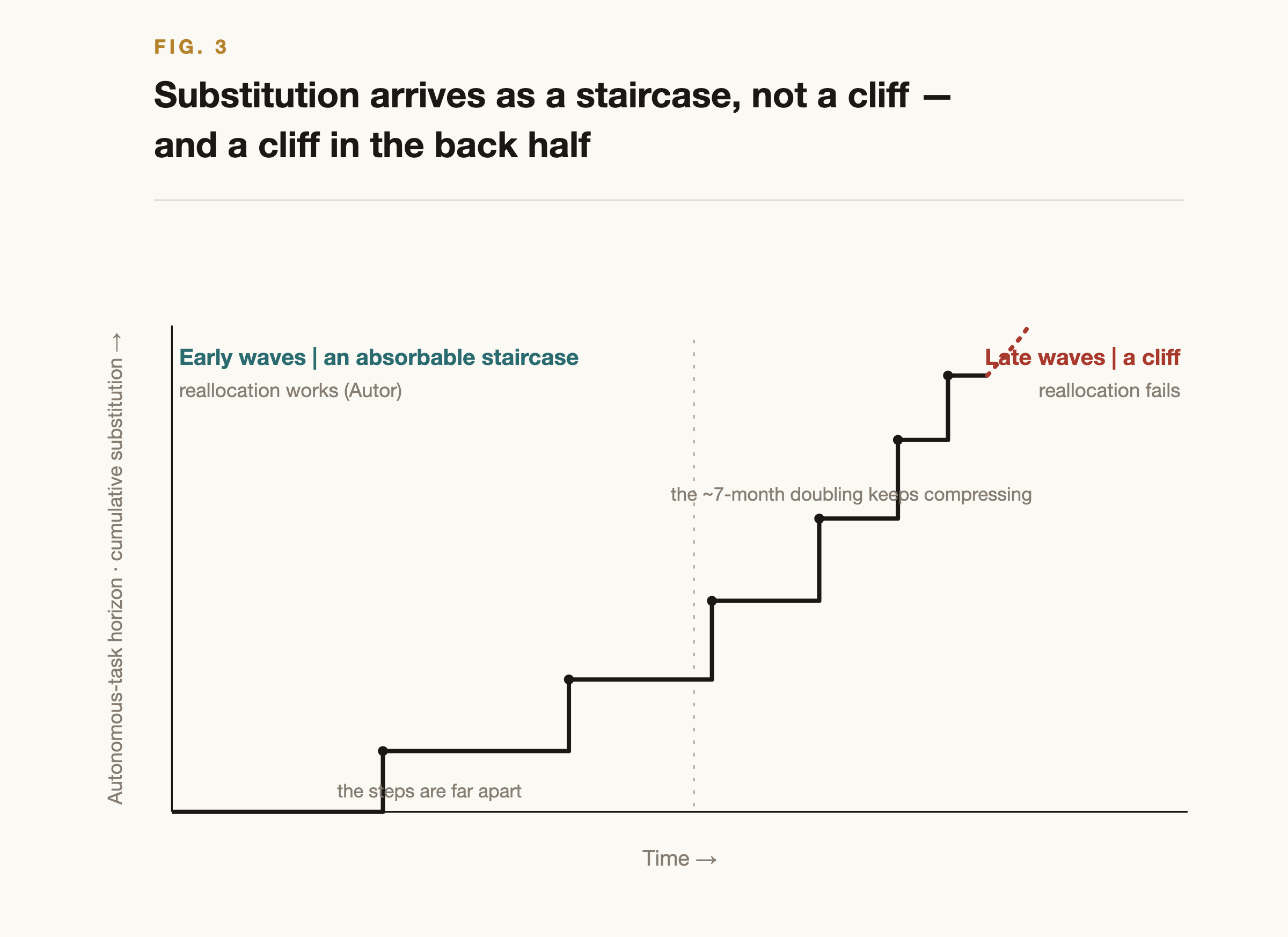
Figure 3, The staircase of substitution. Each time the horizon crosses a threshold, a band of roles falls at once; as the doubling clock shrinks, the back half approaches a cliff.
This is why the optimists are right early and the pessimists right late: a snapshot taken in the gentle early stretch flatters the optimist, while the same trend read out to the steep back half vindicates the pessimist. The physical fortress is a short-term refuge; the legitimacy fortress is a permanent home.
TL;DR: What is born is the two ends of the barbell, a few AI specialists and the low-wage frontline roles that grow most in number. The clerical middle vanishes. Sorted by why they resist AI, the new roles fall into six families; the most durable are in responsibility and assurance, which the EU AI Act is creating as law.
I checked the jobs being born against primary sources.
Table 12, Verification data on jobs and industries being born (primary sources, 3-vote check)
| Claim | Verification data | Type | Source |
|---|---|---|---|
| Net job gain | 170M created and 92M displaced by 2030, net +78M. The net gain specific to AI / information technology is about 10M | Forecast (survey) | WEF Future of Jobs 2025 |
| Fastest growth rates | Big data ~110%, fintech ~95%, AI/ML ~85% | Forecast (survey) | Same |
| Largest absolute growth | Frontline roles — agriculture, delivery, care (not tech roles) | Forecast (survey) | Same |
| Usage in practice | Consumer-facing Claude.ai skews toward augmentation but wavers; enterprise and API skew toward automation (about three-quarters to 97%) | Measured | Anthropic Economic Index |
| Regulation-driven demand | EU AI Act Article 4 (AI-literacy obligation, in force February 2025, legally binding) | Legal fact | EU AI Act official |
| The provenance standard | C2PA is a multi-party standard under the Linux Foundation (Adobe, Microsoft, Google, OpenAI, and others) | Fact | C2PA official |
What is born is the two ends of the barbell: the AI specialists who lead on growth rate (few in number) and the frontline roles that grow most in absolute terms (low in wage). The clerical middle disappears. The most durable new roles are in the territory of responsibility and assurance, and the EU's AI Act is creating these as a matter of law, one of the few cases where the theory is corroborated by a regulatory implementation rather than by forecast.
The barbell says where the new work sits; it does not say what it is. Sort the new and surviving human work by why it resists AI, the capability-versus-legitimacy axis of Part 4, and six families appear, each with a different shelf life and a different wage.
Table 12b, The six families of new human work
| Family | Examples | Why it resists AI | Durability and wage | Absorbs the displaced? |
|---|---|---|---|---|
| Accountability / assurance | AI auditor, AI-liability underwriter, AI officer | Legitimacy: a suable, licensable signer | Long, high wage | No, few in number |
| Relationship / care | care, therapy, high-trust advisory, relationship sales | Legitimacy: reciprocity a machine cannot hold | Long, low to mid wage | Yes, the volume sink |
| Physical last mile | trades, complex manipulation, AI-directed field work | Capability: Moravec, expiring on a clock | Medium, mid wage | Partly, while the clock runs |
| AI-enabling | RLHF raters, evaluators, agent orchestrators, red-teamers | Mixed, mostly transitional | Short to mid, mid wage | Briefly, then self-erasing |
| Meaning / authenticity | performers, artisans, verified-human creators, hosts | Demand-side scarcity: a human did it | Medium to long, dispersed wage | No, niche |
| Frontier judgment | curators, the filter for infinite AI output | Capability is weak, but the demand is strong | Short as a skill, high at the top | No, few |
Two of the six are genuinely new rather than merely surviving. AI-enabling work (humans rating, correcting, and red-teaming model outputs) is already a multi-billion-dollar human-labor market: one vendor alone, Surge AI, reached roughly $1.2 billion in revenue in 2024. Yet it carries the recursion trap of Part 4 in its sharpest form, because the better the models get the more of this training work they absorb, which makes it the least durable family even as it grows fastest today. The other genuinely new family is the one Part 9 develops: work that exists only because the party doing the hiring is an AI agent rather than a human.
Plotted on two axes, the volume of displacement a family absorbs against the wage it pays, the six leave one quadrant conspicuously empty.
                        high wage / long-lived
 accountability·assurance │
 frontier judgment        │         (empty)
                          │
 ─────────────────────────┼─────────────────────────  volume absorbed →
 meaning·authenticity     │  relationship·care
                          │  physical last mile
                          │  AI-enabling (wage falling)
                        low wage / short-lived
The empty top-right is the whole problem in one picture: no new family both soaks up the displaced middle and pays it a middle-class wage.
The obvious objection is Autor's: most of today's employment sits in job categories that did not exist in 1940, and every prior wave looked, from inside it, like an empty quadrant until new middle work filled it within a generation. The claim here is not that no new work will appear. It is that the escape valve every prior wave used, non-routine cognition, is this wave's explicit target, so the quadrant may well fill again, but through a door that is narrower and slower than before, and the transition is where the damage lands.
The families also sit at different points on the erosion clock of Part 7 (Table 11). AI-enabling work, the fastest-growing today, erodes first, reabsorbed as the models improve; frontier judgment-as-a-skill follows, though the curation service outlives the skill; physical last mile holds until the 2030 to 2035 physical wave; and accountability, relationship, and meaning sit out in the indefinite Wave 3, gated by legitimacy and culture rather than by capability. The cruel symmetry is that the family growing fastest now has the shortest clock, while the longest-lived families persist by social choice rather than market reward, which makes their durability a political fact more than an economic one.
And automation, recall, already dominates in the enterprise; the augmentation skew is the picture only when you crop to consumer use. Do not misread "AI is an assistant for now" as permanent safety: that is reading a transitional state as a terminal one.
TL;DR: New demand clusters in the complement of what AI commoditized, trust, responsibility, relationships, meaning. The business sweet spot is the accountability and assurance that regulation guarantees. The agent economy's payments and standards are already held by incumbents. Detailed scores follow, closing with a map of how value actually reaches the human.
Parts 1–8 looked at the supply side, occupations, labor categories. This part shifts to the demand side, using Christensen's Jobs-To-Be-Done: what progress people, organizations, and AI agents will newly want to hire for. Occupations are supply-side labor; JTBD are demand-side progress.
AI changes the jobs to be done in three ways:
| Mechanism | What happens | Example |
|---|---|---|
| ① Collapse | AI zeroes out a functional job → it stops being hired and becomes ambient | You no longer hire a translator |
| ② Elevation | The functional layer falls, a meta-job appears one level up | Not "someone who writes" but "someone who decides what is worth writing and vouches it is true" |
| ③ Emergence | A situation that never existed before generates a genuinely new job | "I ran ten agents overnight — I want to know it was done right" |
The unifying principle: every new JTBD clusters around the legitimacy moats of Part 4 (trust, accountability, relationships, meaning) because those are the emotional and social dimensions that turn scarce exactly as AI commoditizes the functional one. The supply-side legitimacy moat and the demand-side new JTBD are the same coin from two sides.
This resolves a tension. In Part 4, taste was the weakest complementary asset to sell as a skill. But on the demand side it inverts: the job "filter the infinite AI output for me" grows strongly. Selling your taste as a skill is weak; serving the hunger that taste-scarcity creates is strong. Likewise the meaning job, when AI makes achievement free, people pay to feel they did it themselves (the Strava/Duolingo/handmade pattern); effort itself becomes a scarce good.
The least-explored layer is the one where AI agents themselves begin to hire. They hire tools and APIs (tool discovery, settling payment, trusting outputs: agentic payments). They hire other agents (delegating subtasks, verifying each other's work, establishing reputation and identity, resolving disputes: the A2A infrastructure). And, in the deepest inversion, agents hire humans, for the physical last mile they cannot do, the accountability they cannot hold, the legitimacy they cannot borrow.
That is the hopeful reversal of the underclass thesis: not "AI takes human work," but a demand in which AI hires the human it cannot itself be. The primitive first form already exists (humans hired to train AI, now a multi-billion-dollar business as Part 8 notes).
The mature form is no longer only hypothetical: an early, venture-backed marketplace, RentAHuman, already lets AI agents post bounties and hire humans through an API and the Model Context Protocol, holding payment until the work is verified, for exactly the regulatory sign-off, physical execution, and interpersonal assurance an agent cannot supply itself. It is nascent and small, but the category now exists in the world rather than only on paper.
And it cuts both ways: the same marketplace is already a channel for laundering what an agent should not do itself. An early measurement study of RentAHuman found that about a third of its bounties came through programmatic (API or MCP) channels, carrying six live abuse classes (credential fraud, impersonation, automated reconnaissance, social-media manipulation, authentication bypass, referral fraud) on sale at a median of $25 (arXiv preprint, 2026). Content screening, the same study found, was effectively absent. So "AI hires the human it cannot be" is at once the hopeful inversion and responsibility laundering, the agent outsourcing the acts it is not permitted to commit. The entire institutional layer that human society took millennia to build (identity, reputation, trust, payment, verification, dispute resolution) is what the agent economy will need in a few years, and the early evidence is that it does not have it yet.
I enumerated these intersections as 24 business options and scored them on four axes: demand strength J, moat buildability M, market size, and actor fit (S = startup, E = incumbent, B = both).
Table 13, Scores for major business options (J + M + market, 15 total)
| Business | J | M | Market | Fit | Total |
|---|---|---|---|---|---|
| A2A payments | 5 | 5 | 5 | E | 15 → revised 12 |
| AI insurance / liability underwriting | 5 | 5 | 4 | E | 14 |
| Agent ID / reputation | 5 | 5 | 4 | S | 14 → revised 12 |
| AI audit platform | 5 | 4 | 4 | B | 13 |
| Domain-specific AI assurance | 5 | 5 | 3 | S | 13 |
| A marketplace where AI hires humans | 5 | 4 | 4 | S | 13 |
The top band clustered into two: the accountability domain where regulation creates demand, and the infrastructure of the agent economy. (The arrows in Table 13 mark the two scores the empirical check below revised downward.)
Verifying these two against real companies, funding, and standards forced a clear revision.
Table 14, Empirical check on the business options
| Cluster | Reality | Winner |
|---|---|---|
| AI insurance | Munich Re aiSure (since 2018, covers hallucination), Armilla (an MGA model riding Lloyd's underwriting capacity) | Incumbent capacity × startup product design |
| AI audit | Credo AI (raised over $40M, Mastercard a customer), Holistic AI | Startup-led |
| A2A payments | Google AP2, Stripe / OpenAI's ACP, Visa, Mastercard control the standards | The incumbents |
| Agent ID | Incumbents like Okta entering; no independent startup confirmed | Tilts to incumbents |
The conclusion was clear. The payments and standards of the agent economy are already being seized by Google, Stripe, Visa, and Mastercard. This is the payments version of the market-structure chapter's point: the true competitor is the distribution platform, and the incumbent integrates forward.
What is left for startups is the accountability / assurance domain where regulation guarantees the demand, and the empirical detail deserves precision. AI insurance is already live and working: Munich Re's aiSure has covered hallucination and AI error since 2018 (covering, not excluding), and Armilla writes affirmative AI-liability cover on Lloyd's capacity with an underperformance trigger. The structure is exactly the one the discussion predicted: the incumbent supplies the capacity, the startup supplies the AI-specialized product design and distribution, the MGA (managing general agent) model. AI audit is well-funded and startup-led (Credo AI has raised over $40M with Mastercard as a customer). And the demand is legally time-stamped, not speculative, though the stamp has moved once: the EU AI Act's high-risk obligations, originally set to phase in through 2026–2027, were pushed back by the 2026 Digital Omnibus and now arrive through 2027–2028 (standalone high-risk systems from December 2027, product-embedded ones from August 2028). The delay moves the date without removing the mandate, and it is a reminder that regulatory timetables are a political variable, not a constant.
Generalize the finding and AI businesses form a layer cake, with incumbent-held and startup-held layers alternating:
┌─ Application / vertical layer ──── startups win (thin but many)
├─ Standards / protocol layer ────── incumbents (AP2 / ACP / MCP) ← taken
├─ Rails / payments / ID layer ───── incumbents (Visa / Stripe / Okta) ← taken
├─ Regulatory-assurance / insurance ─ startup + incumbent hybrid (the A cluster) ← remains
└─ Model layer ───────────────────── the top three (Part 3)
Incumbents hold the horizontal standards and rails; startups remain in the vertically specialized apps and the assurance that regulation requires. The assurance layer stays open to startups precisely because it is split vertically by regulation and domain, demands actuarial/audit expertise, and finds incumbents (insurers, the Big Four) holding capacity and brand but not AI-specialized product design. This is the business-level form of Part 4: startups lose on distribution and capital but win on proprietary data and domain trust. One caveat cuts against this from the Conclusion's side: regulation is itself a complementary asset that incumbents help write, so the assurance opening stays open only where vertical, domain-specific expertise outweighs the incumbent's hand on the rules. Where compliance cost is the whole game, the layer closes.
Three spaces remain for startups. First, vertical apps on top of incumbent rails: the payment standard is taken, but implementing agent commerce for a specific industry (medical procurement, construction materials, B2B wholesale) on top of it is not; the value is industry knowledge and compliance. Second, the MGA model: the startup carries no capital, riding incumbent insurance capacity while owning the AI-specialized underwriting and distribution; an MGA for a specific AI risk (medical, legal, autonomous agents) is "the tap on AI adoption." Third, vertical regulated-assurance specialists: once the EU AI Act regulates a high-risk domain, each domain (medical, hiring, credit, education) needs its AI audited and assured by a specialist; horizontal audit raised the money, but vertical specialization stays with startups.
The traps to avoid are the mirror image: competing on horizontal infrastructure (payments, ID, orchestration standards, already incumbent-held), ambitions to be "the OS of the agent economy" (MCP/AP2 are top-three standards you'd be parasitic on), competing on model performance (you lose to the top three), and post-regulation compliance SaaS (commoditizes). The winning formula:
Win = vertical specialization (a narrow domain) × regulation-guaranteed demand (J assured) × expertise incumbents lack (actuarial / clinical / legal), and do not compete on horizontal infrastructure, standards, or the model.
This is the convergence point of the whole analysis: the best opportunity is neither "building AI" nor "AI infrastructure" but absorbing the assurance, insurance, and responsibility that society demands as law when AI enters regulated, high-risk domains. Part 1 (the insurability of responsibility) → Part 4 (the legitimacy moat) → Part 8 (regulation-driven new roles) → the empirical check here (Armilla, Credo AI are real) all point to the same place. It is a third answer, grounded in evidence, distinct from both the booster's ("the next unicorn is the app layer") and the doomer's ("the top three take everything").
The taxonomy of Part 8 says what work exists; it does not say whether the worker is paid enough to live on. That turns on the channel through which value flows back to the human, and the channels split into two families.
The market channels price the work directly. Wages are the familiar one, and the shrinking one, as labor's share falls. Above wages sits ownership: converting Set B into an equity claim on the rent (Part 4), the only market channel that pays out of the concentrating side rather than the shrinking side. Then the human-feedback and gig channel (RLHF rating, data work, task bounties), already a real labor market but a self-erasing one. And newest, the agent-hires-human channel above, where the buyer is an AI rather than a firm.
One more market channel works by removal rather than by payment, and it reaches a population every other channel misses. Call it labor-supply liberation: AI pays the unpaid carer nothing; it removes the constraint that kept them from earning at all.
The pool is measured, not hypothetical: 647 million working-age people (606 million of them women) are outside the labor force because of unpaid care responsibilities, the largest single pool of participants lost to the labor market (ILO, 2018), and a majority of the women among them say they would prefer paid work (58%, ILO-Gallup, 2017).
The mechanism is not speculative either; it is the documented engine of the last sixty years. As household production marketized, its share of adjusted US output fell from 37% in 1965 to 25% in 2020 (BEA), and that marketization was the female labor-force revolution.
AI extends it through three routes, in rising order of difficulty: making employment schedule-compatible with residual care (remote work plus AI monitoring turns "must be present" into "must respond"); cheapening paid care services (an AI-augmented human care worker rather than a care robot, which keeps a responsible human in place and so sidesteps the insurability gate of Part 1); and automating the drudgery share directly (81.8% of unpaid care hours are household work such as cooking, cleaning, and shopping, against 13.0% direct personal care (ILO), and that household share sits squarely in the 2030 to 2035 physical wave of Part 7).
The relational core is the slowest corner of Part 1's insurability matrix (catastrophic, irreversible, an identifiable victim), and it should be; liberation does not require automating it, only compressing the hours around it.
Three limits. The income created is mostly low-to-mid wage, into the barbell market of Part 2, though the right comparison for this pool is not the middle-class wage but zero. Much of the conversion is unpaid care becoming paid care, the same activity with a wage, social insurance, and a pension attached, a real welfare gain that can look like relabeling. And it reaches a different population from the displaced middle, so it does not fill the empty quadrant of Part 8.
What it uniquely adds is macro: it converts non-earners into high-MPC earners, one of the few endogenous counterforces to the MPC gap of Part 5, and, like the redistribution arithmetic of Part 6, it aligns with the industry's own interest, adding labor supply and final demand at once.
The non-market channels do not price the work; they distribute the rent by policy. Robot-funded redistribution (a UBI paid out of automated production) is, as Part 6 showed, the industry's profit-maximizing move rather than charity, because it props up the demand the labs sell into. A sovereign-equity or public-wealth-fund channel hands out a claim on the capital stock instead of a wage, and the precedents are real if small: the Alaska Permanent Fund (about $89 billion, paying every resident an annual dividend) and Norway's Government Pension Fund Global (around $2 trillion, owning roughly 1.5% of all listed companies on behalf of its citizens). A data-dividend channel would pay people for the training data their behavior produces, so far a proposal (California floated one in 2019) rather than a working system.
Lay the supply taxonomy against the channels and the uncomfortable synthesis appears.
Table 14b, New work against the channel that pays it
| New-work family | Pays through | Net effect on distribution |
|---|---|---|
| Accountability / assurance | wage + equity | few, well-paid, claims some rent |
| Relationship / care | wage | many, low pay, no claim on rent |
| Physical last mile | wage + agent-hire | moderate, mid pay, time-limited |
| AI-enabling / feedback | gig + agent-hire | self-erasing, mid pay and falling |
| Meaning / authenticity | market, niche | niche, dispersed |
| Frontier judgment | wage + equity | few, high pay, claims rent |
The pattern is the one the whole report keeps finding. The new work that absorbs volume (care, last mile, gig) pays low; the new work that pays well (accountability, frontier, the equity conversion) is small in number. No market channel routes the displaced middle into comparable wages. So the distribution question of Part 5 cannot be closed on the market side alone, which is exactly why the weight falls onto the non-market channels, and why "redistribution is the industry's profit-maximizing move" stopped being a moral claim and became an arithmetic one. Access to the new work equalizes; the wage it pays, and the claim on the rent it carries, do not.
If the weight falls onto the non-market channels, the next question is whether they can bear it. They are not equally feasible, and Part 11 rated the redistribution scenario (P3c) as low-confidence and politics-dependent; this refines that rating channel by channel.
Table 14c, Feasibility of the non-market channels
| Channel | Feasibility | Precedent | Scale |
|---|---|---|---|
| Sovereign-equity / public wealth fund | Medium; the constraint is political will, not design | Strong: Alaska and Norway already run at scale | Large |
| Robot-funded UBI | Low to medium; Part 6 makes it the industry's own profit-maximizing move, but it is politically unproven beyond pilots | Weak: pilots only | Large |
| Data dividend | Low; no working implementation, and the per-person valuation problem is unsolved | None: proposal only | Uncertain |
The ranking is the useful part. The channel with a real track record, sovereign equity, is the most feasible; the one with only a slogan, the data dividend, the least. And the most feasible channel is the one that pays out of the concentrating side (the rent) rather than the shrinking one (the wage), which is why a public stake in the capital stock, more than a wage-like UBI, is the cleanest market-external answer to a distribution problem the market cannot close on its own.
TL;DR: AI grows the pie as well as substitutes, but the effect is wildly uneven across domains: it expands what is computationally searchable by orders of magnitude, while the physical and experimental loop stays the bottleneck (an Amdahl's law for science). New GDP does come, but on the 10-to-15-year timeline of the physical and the clinical, not the media's.
The analysis so far has implicitly run on the frame "AI = automating existing tasks (substitution and cost reduction)." But AI has another route.
Table 15, Three routes for the AI economy
| Route | Effect | Action on GDP |
|---|---|---|
| Substitution type | Automates existing labor | Cost reduction, demand erosion (contracts) |
| Discovery type | Makes possible what is now impossible | New goods, lifting of supply constraints (expands) |
| Transaction-cost type | Enables transactions that never closed | Surfacing of dormant demand (expands) |
Deep tech (drug discovery, fusion, materials) is the stage for the discovery type. Technical risk dominates, and AI can compress its resolution through parallel loops of trial and verification. This direction is correct, and it accurately picks out what the substitution-type analysis missed. But the degree of effect differs by orders of magnitude across domains.
The key is how much of the verification loop closes inside computation. If verification runs through the physical, then no matter how fast the computation, the whole is bound by the physical. An Amdahl's law for science.
Table 16, Ordering of deep-tech domains (search space S / computational closure I / data D / physical-loop speed P / regulatory lightness R, 25 total)
| Domain | Total | Rate-limiter |
|---|---|---|
| Protein design / structure | 23 | Almost none |
| Materials science (catalysts, batteries) | 19 | Synthesis, evaluation |
| Chemical synthesis | 19 | Automated synthesis lab |
| Drug discovery (preclinical) | 18 | Cell and animal experiments |
| Semiconductor design | 18 | Manufacturing (fab) extremely costly |
| Fusion | 13 | Building real machines, material irradiation |
| Space / launch | 12 | Physical launch, capital |
| Drug discovery (full clinical) | 11 | Clinical trials, regulation |
Surprisingly, the flashy domains the media hype (fusion, new drugs, space) carry incompressible rate-limiters, the physical, the clinical, capital. The unglamorous domains (proteins, materials, catalysts) close inside computation, and AI works well. The deep tech where AI truly works points the opposite way from the attention.
Table 17, The evidence for an Amdahl's law for science (primary sources, 3-vote check)
| Stage | Data | Source |
|---|---|---|
| Compression on the compute side | AlphaFold's database went from 360k to 200M structures (over 500x) | DeepMind / EMBL-EBI |
| Compression on the compute side | GNoME predicted 380k stable materials (an order-of-magnitude expansion from the ~48k known) | Nature 2023 |
| Realization lags prediction | Of GNoME's ~380k predicted stable structures, 736 had so far been independently realized by other labs in concurrent work, a lower-bound validation signal rather than a synthesis-success rate | Nature 2023 |
| The drug-discovery rate-limiter | $1–2.6B per drug, 10–15 years. Most of it is clinical. No evidence AI raised the clinical success rate | Industry data |
| Fusion | AI learned to control existing tokamaks. The rate-limiter of building the real machine is unchanged | Nature 2022 |
AI's effect on deep tech is sharply asymmetric: on the computation side it expands what is searchable by orders of magnitude, while on the physical side realization stays the bottleneck. GNoME's ~380,000 predictions are stable-structure candidates rather than demonstrated materials, only a small fraction independently realized so far, and critics have argued many are trivial extensions of known compounds rather than useful new materials. That asymmetry, not a single conversion ratio, is what an Amdahl's law for science names. AI expands the "pie of the possible" explosively, but the speed at which it turns into a "pie of realized GDP" is bound by the speed of the physical-world loop. New GDP does come. But not at the speed the media expects (fusion and new drugs ripening all at once within a few years), it comes on the timeline of the physical, the clinical, and the regulatory: 10 to 15 years.
Even without deep tech, AI grows the pie by erasing transaction costs, reaching layers that services never reached before. Generative-AI tutoring in Nigeria produced a 0.3-standard-deviation learning gain in six weeks (the top 20% of interventions in the developing world). Kenya's Jacaranda delivers AI triage to 3 million mothers at $0.74 per person over a lifetime. This is not substitution but net addition, and it reaches the bottom. Two pilots are not yet a civilizational pattern, so treat this as suggestive rather than proven; but on the evidence available it is among the most equalizing forms of pie creation, and the bridge to Part 11.
In the macro aggregate, though, every credible estimate attributes most of the GDP effect to productivity (cost reduction) and treats new demand only as an uncertain upside. Acemoglu's conservative TFP estimate is 0.66% or less over ten years. The "trillions" in the headlines are productivity, not new demand.
TL;DR: Whether the picture is pessimistic or optimistic is a question of which metric you choose. Rent → pessimistic, GDP → neutral, benefit (consumer surplus) → optimistic. But benefit is a different ledger from rent: it reframes the picture, it does not resolve the distribution problem.
The analysis so far has leaned structurally toward pessimism. Deliberately enumerating the positive scenarios, not as a wish-list but by gathering the positive signals scattered across the earlier parts and rating each by its condition, confidence, and scale, the logic that breaks the dark conclusion comes down to four routes, and within them sixteen concrete scenarios.
Dark conclusion = substitution erodes demand × rent concentrates × distribution doesn't improve
Four ways to break it:
 P1 Substitution never completes (technical/physical limits) → labor remains
 P2 The pie outruns the distribution problem (growth is overwhelming) → everyone richer
 P3 Rent disperses (concentration breaks) → distribution improves
 P4 Non-market value grows (welfare outside GDP) → a different abundance
Table 18a, P1: Substitution never completes
| Scenario | Condition | Confidence | Scale |
|---|---|---|---|
| P1a Capability plateau | Scaling stalls → augmentation equilibrium | Low (evidence denies it) | Large |
| P1b An Amdahl's law for science | Physical/regulatory rate-limiters (Part 10, realization lags prediction) → transition time | Medium–high (empirical) | Medium |
| P1c The comparative-advantage floor | Finite compute leaves low-value tasks to humans | Medium | Medium (low wage) |
| P1d The regulatory / legitimacy wall | Society won't entrust it to AI (the legitimacy moat) | Medium–high | Medium |
Table 18b, P2: The pie outruns distribution
| Scenario | Condition | Confidence | Scale |
|---|---|---|---|
| P2a Deflationary abundance | Price collapse > income collapse | Medium (Baumol goods bind) | Large |
| P2b Discovery-type TFP explosion | In-silico new goods realized | Medium (slow, physical rate-limiter) | Large (long run) |
| P2c New services to the underserved | Transaction costs vanish → the priced-out | High (empirical, most equalizing) | Medium–large |
| P2d Care liberation (labor-supply release) | AI compresses unpaid-care hours (schedule-compatible work, cheaper paid care, automation of the 81.8% household share) → part of the 647M carers outside the labor force re-enters paid work (Part 9) | Medium–high (the marketization mechanism is historically proven; the relational core is the slowest insurability corner) | Large (high-MPC income for a 647M pool) |
Table 18c, P3: Rent disperses
| Scenario | Condition | Confidence | Scale |
|---|---|---|---|
| P3a The open-weight floor | OSS tracks the frontier (~3 months) → access to capability equalizes | High (empirical) | Medium |
| P3b A capital-market bust | The bubble bursts → capital destruction compresses inequality | Medium (a cruel form) | Medium |
| P3c Public wealth fund / redistribution | Policy intervention | Low (depends on politics) | Large |
| P3d AI hires humans | AI hires humans for the legitimacy moat → new labor demand | Medium (immature) | Medium |
Table 18d, P4: Non-market value grows (welfare outside GDP)
| Scenario | Condition | Confidence | Scale |
|---|---|---|---|
| P4a Liberated time | Work hours fall → leisure, creation | Medium (depends on distribution) | Large |
| P4b Democratized knowledge / education | Everyone reaches expertise → human-capital lift | High (empirical) | Large |
| P4c Cognitive augmentation / creativity | AI augments the individual | Medium–high | Large |
| P4d Scientific progress itself | Disease, climate, energy | Medium (slow, physical rate-limiter) | Very large (long run) |
The empirically grounded, high-confidence positives (the ★ band) are P2c (new services to the underserved, the most equalizing), P4b (democratized education, the consumer-surplus explosion), P1b (the Amdahl's-law transition time), and P3a (the open-weight floor, equalized access to capability). One scenario sits just below the band: P2d (care liberation, the channel of Part 9), whose mechanism is historically proven (the marketization of household production) while its AI-specific extension is directional rather than measured. Mapped on confidence against scale:
            scale: large
 P1a plateau   │ P4b education★   P4d science
 P2a abundance │ P2c underserved★ P4a freed time
 P3c redistrib │ P2d care liberation
 ──────────────┼───────────────────── confidence →
               │ P1b Amdahl★   P3a OSS floor★
               │ P1d legitimacy   P3d AI-hires-human
            scale: small        (★ = empirically grounded, high confidence;
twelve of the sixteen scenarios plotted)The central reframing of this report is here, and the qualitative version of it is the report's strongest claim: the pessimism so far was almost entirely the result of measuring by a single metric, the distribution of excess profit (rent). Change the metric and the picture changes. That qualitative claim holds.
The data points below are verified. The single ratio I draw from them is softer, as the next paragraphs make explicit.
Table 19, Verification data for the "benefit" metric (primary sources, 3-vote check)
| Claim | Data | Type | Source |
|---|---|---|---|
| Most of the benefit goes to consumers | Of the social benefit of technological innovation, producers capture about 2.2%; the remaining ~97.8% flows to consumers and society (1948–2001) | Historical estimate | Nordhaus, NBER w10433 |
| AI's consumer surplus dwarfs its rent | US generative-AI consumer surplus was about $97B in 2024 and $116B to 7B 2024 US generative-AI revenue (the paper's grouping, one wider than this report's top three), and revenue has grown materially since, so the current ratio is lower | Model estimate | Stanford Digital Economy Lab 2026 |
| It doesn't show up in GDP | This benefit arises before it appears in productivity or GDP statistics (the paper's explicit statement) | Methodological | Same |
| It is widely dispersed | ChatGPT reached roughly 10% of the world's adults by mid-2025, and the majority of use was outside of work | Measured | Stanford HAI 2026 |
| Precedent in free digital goods | By the GDP-B estimate, $2.52T across 13 countries (equivalent to 5.95% of GDP) | Estimate | NBER w25695 / PNAS 2019 |
Three metrics give three conclusions. And every one of them is correct.
Table 20, Three metrics, three conclusions
| Metric | Conclusion | Why |
|---|---|---|
| Rent (wealth) | Pessimistic | Concentrates in capital and platforms |
| GDP | Neutral | It grows, but productivity-led, and labor's share falls |
| Benefit (consumer surplus) | Optimistic | Free AI delivers expertise, education, health, and creativity to billions |
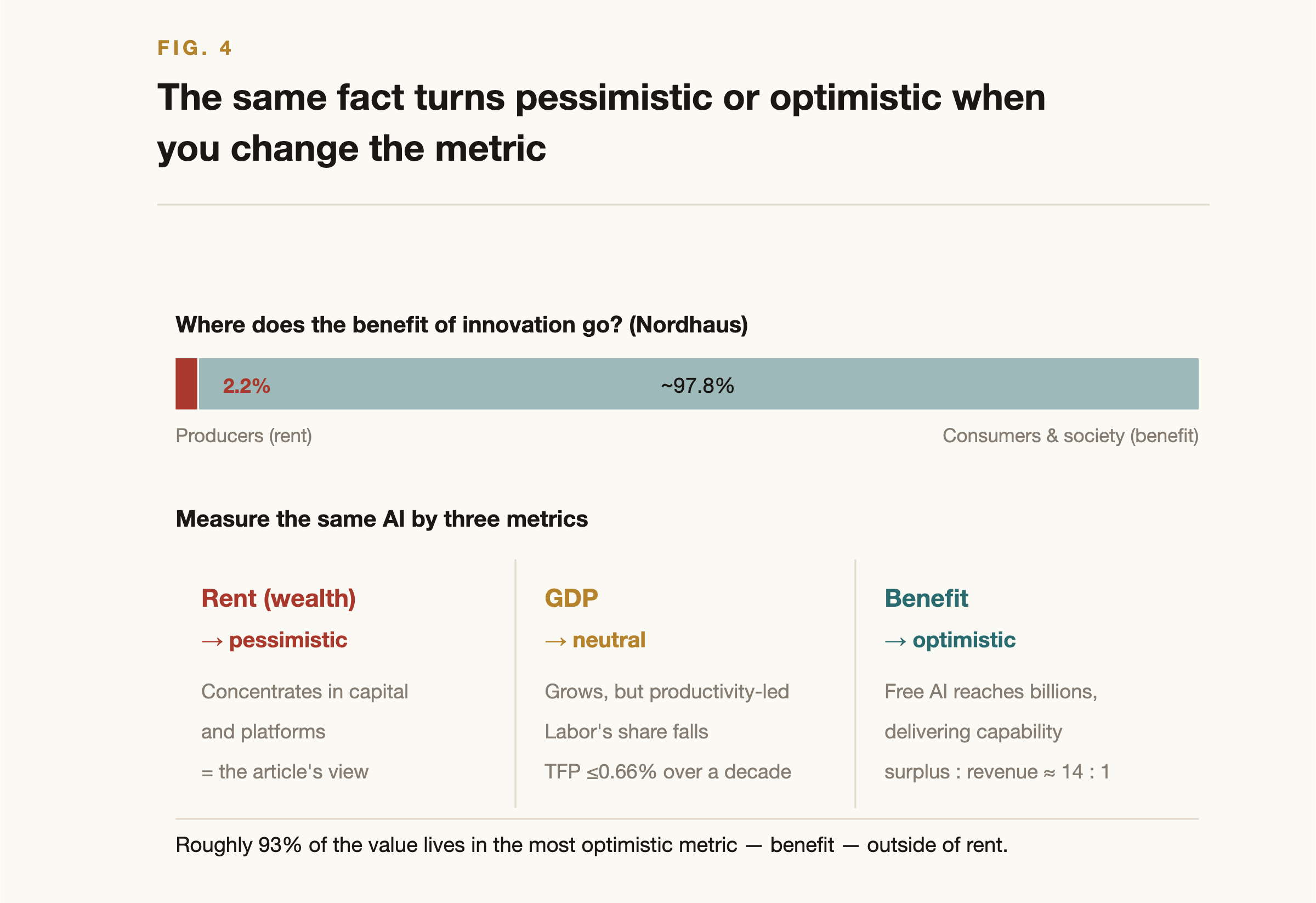
Figure 4, The distribution of value and the three metrics. Historically about 97.8% of the social benefit of innovation has flowed to consumers and society (Nordhaus); the three metrics, rent (pessimistic), GDP (neutral), benefit (optimistic), give three conclusions.
AI concentrates rent, lifts GDP gently, and explodes consumer surplus. It does all three at once. On the available numbers most of the value sits in the most optimistic metric (benefit), outside of rent. How much is an estimate rather than a fixed share, and exactly how soft that estimate is deserves spelling out.
The figure is AI-specific, derived from the roughly 14-to-1 ratio of US generative-AI consumer surplus to revenue (Table 19). Treat total benefit as surplus plus revenue, and revenue (the rent) is about one-fifteenth, leaving roughly fourteen-fifteenths, about 93%, as consumer and social benefit. Three caveats keep this from being a hard number. First, the numerator is a model-dependent consumer-surplus estimate, the softest kind of figure, and willingness-to-accept methods are known to run large, so treat the ratio as directional, not precise.
Second, the denominator is both narrow and stale: the $7B is the four largest labs' 2024 US generative-AI revenue, which the ratio pairs with the 2024 surplus, and revenue has grown materially since (OpenAI alone now runs in the billions), so the 14-to-1 is a 2024 reading and the current ratio is lower, not higher. Whether even a compressed ratio stays lopsided depends on the thin moat of Part 3: if the moat stays thin, competition keeps rent from being captured and a high benefit share persists; if monetization thickens the moat, the share compresses further.
Third, and most important, benefit is not the same ledger as rent. Consumer surplus cannot be banked, taxed cleanly, or handed to someone who has lost a wage; it does nothing, by itself, for the demand-realization problem of Part 5. A large benefit share coexists with a concentrated rent distribution, it does not cancel it. Nordhaus's "2.2% to producers, 97.8% to consumers" is a separate estimate of a different thing (the historical split for innovation in general); its closeness to the AI figure is suggestive, not corroborating. Two soft numbers landing near each other do not confirm one another.
A few things follow, depending on where you sit.
If you are deciding where to stand professionally: do not try to out-compete cheap cognition, and do not over-invest in "taste" or raw judgment, which is where the models are climbing fastest. Put the weight on the legitimacy assets, accountability, trust built through time spent exposed to risk, genuine relationships, and on converting those into ownership: equity, a proprietary feedback loop, customers of your own. Access to intelligence won't set you apart, because everyone will have it. What you pair it with will. And start now, while the machines still need you in the loop, because the assets that survive take years of risk-exposed work to build.
One honesty check on this advice, though: it is individually rational but not a collective solution. Not everyone can hold a scarce, accountable, legitimacy-backed role, that is what scarce means, so this tells you how to improve your own odds, not how the displaced middle as a whole lands safely. That second problem is the one only policy can answer, and no amount of individual ladder-climbing substitutes for it.
If you are reading the macro picture: plan for volatility, not apocalypse. The underpriced risk is not mass permanent unemployment; it is a financial correction in an over-leveraged, circularly financed build-out, alongside a hard squeeze on early-career knowledge workers in the most automatable fields. The fragility of that build-out is well-documented; its timing and scale are not, so treat "a correction is coming" as a direction rather than a date (the IPO disclosures are the thing to watch). Treat this augmentation era as a window, and resist reading "AI can't fully do this yet" as "AI won't."
If you are building this: notice that redistribution here is not charity. Because the labs sit downstream of consumer demand, propping that demand up is the profit-maximizing move: it raises the level of displacement reachable before the industry starts eating its own market. "Automate the worker, then make sure someone can still afford the output" is, on the arithmetic, the optimal strategy, not generosity. The companies warning about an underclass while building toward it aren't necessarily hypocrites; they are describing a problem already visible in their own revenue line, and have not yet decided whether they intend to solve it.
The New York Times's underclass thesis is correct on the rent metric. Economic power (wealth) concentrates. But seen through the "benefit" metric, the picture is the opposite: "the era in which more people than ever can reach for expert-grade capability."
The most honest positive scenario comes not from hunting for optimistic facts but from choosing the right metric. Material abundance and access to capability become more equal: that is the benefit side. Economic power concentrates: that is the rent side. The two do not contradict; they happen at once.
Nor does the concentration contradict Part 3's finding that the moat on intelligence is thin, because the two describe different layers: the rent on raw intelligence disperses (open weights a season behind, enterprise share that changes hands), but wealth pools one layer out, in the scarce complements the cheap intelligence runs on, capital, distribution, proprietary data, and gated frontier access, the Set A of Part 4. Commoditizing the core, as Teece and Christensen both predict, tends to send the profit to whoever owns the adjacent scarce asset, so "the moat is thin" and "wealth concentrates more than ever" can be the same event seen at two layers.
Two limits on that reconciliation. Much of the capital and distribution concentration it points to predates AI, the ordinary tendency of capital to compound; what AI specifically adds is the increment on top, and it is that increment, not the inherited baseline, that "more concentrated than ever" has to earn, an increment this report does not quantify, so the superlative is a directional claim rather than a measured one. And the conservation of profit to the adjacent layer is an empirical tendency, not a law: commoditization sometimes compresses the whole pool instead of relocating it (PC-hardware margins fell more than they moved), and among the Set A items it is capital, distribution, and proprietary data that are robust, while gated frontier access, though since confirmed first-party, has already proven the least durable of them (its first iteration held the capability back only for months, leaving a standing gate on safeguard-lifted use alone) and should not be load-bearing here. So the honest form of the headline is directional rather than superlative: wealth concentrates further, through the complements the cheap core does not touch, in the cases where profit relocates rather than compresses. "More concentrated than ever" is the worst case of that direction, not its measured value.
Quality of life can rise even as rent concentrates and labor's share falls. One asymmetry survives inside the hopeful half. Access to capability equalizes, but converting that access into income still runs through the complementary assets of Part 4 (trust, relationships, the standing to bear responsibility, capital), which concentrate. Everyone is handed the tool; not everyone can turn it into a claim on the rent. The benefit side is equalizing in what it delivers and unequal in what it can be cashed into.
"Does AI grow the pie?" and "Does AI save the underclass?" are different questions. The pie grows. But the underclass is a distribution problem, decided not by the size of the pie but by labor's share and where the rent goes. Discovery-type AI lifts GDP, but that GDP flows to whoever holds capital, platforms, and regulation. The expansion of the pie saves "growth," not "distribution."
What the article saw was the rent: the smallest and most concentrated slice of the value. The far larger remainder is benefit, scattered across the billions of people using AI for free, and it does not even show up in GDP. The article was right about the slice it looked at and missed most of the rest. But the two are different ledgers, and it is the slice the article saw, the rent, that decides who can still afford to live. The larger remainder it missed is real, and it pays no one's rent. The article was right to be pessimistic about distribution; it mistook the distribution question for the whole story.
Where we are heading is a future split in two: access to capability more equal than ever, and the wealth and power that access converts into more concentrated than ever. Which face you see depends on which metric you measure by, and the metric that decides whether people can live on it is the grim one.
One caveat. This "split future" is, for now, a near-to-medium-term picture. Because the reprieve is a clock and not a wall, in the long run, once autonomy and reliability have risen far enough, the distribution problem of Part 5 returns to the foreground. The benefit side still holds then (access to capability keeps equalizing; the split in metrics is durable), but the concentration of wealth can deepen further. So this is not a license to relax about the long run; it makes the question of how to handle distribution before the clock runs out more urgent, not less.
One prior belongs in the open here rather than in a bracket, because it bears more directly on the headline question than almost anything modeled above. Mechanization, electrification, and computerization each drew a near-identical "permanent underclass" prophecy, and each missed in the apocalyptic form. That base rate cuts in this report's favor on the verdict: it is one more reason the end state is not a permanent underclass, which is what the report concludes. Its real pressure falls one level in, on tempo and severity, the claim that the transition is faster and its crises deeper than before.
And the defensible "this time is different" is narrow and specific: the prior waves displaced muscle and routine cognition while leaving non-routine cognition as the refuge humans climbed into, whereas this wave targets that refuge itself. The destination is the same; what is new is that the escape valve every prior transition relied on is the thing now being automated. So the base rate disciplines the speed, not the verdict.
A word on the politics, since the conclusion leans on it. Calling this "a societal choice" can sound like the choice is open and neutral. It is neither. The same concentration this report traces hands the holders of Set A a direct lever on the rules: regulation is itself a complementary asset, and incumbents shape it to entrench, through compliance regimes only they can afford, safety framings that double as moats (the gated frontier of Part 3), and standards bodies they already sit on (Part 9).
The distributional fight is not downstream of the policy choice; it runs through who writes the policy. And the rupture of Part 5 is contested by whoever has political voice, which the excluded, by construction, have least of. None of this is modeled here, and a full political economy would be a different report; flagging it is the honest minimum, because the distributional outcome is set as much by this contest as by the economic mechanisms above.
And the largest contest of the politics and policy ahead will probably be how to handle that split itself.
This report was built from the April 2026 New York Times opinion piece, reasoning one step at a time within economic frameworks, then putting that reasoning through a multi-stage verification against primary sources. Verification used a generative-AI research harness across 17 runs in total. Each run consisted of roughly 100 search agents, about 25 primary sources, and a 3-vote fact-check. One limitation of this method should be stated plainly: a multi-agent vote is not the same as independent verification. Agents drawing on overlapping training data and the same public sources can share the same blind spots, so a majority vote narrows error without guaranteeing independence.
Two deeper limits follow. First, the check catches fabricated numbers but not framing or selection bias: in a discourse as self-referential as AI economics, where labs, investors, and commentators cite one another, a multi-agent harness tends to reproduce the dominant framings (both the hype and the doom) rather than escape them. Second, the run count and the rejection process are not externally auditable, so the rejection list below is offered as disclosure, not as proof. Where a claim mattered it was traced to a named primary source and confirmed by direct retrieval in session, with the vote acting as a filter rather than the final authority. Claims that did not pass (several well-known bubble statistics, model-collapse claims, particular companies' margin figures, the specific requirements of ISO 42001, the funding sizes of some startups) were removed from the text.
Notably, the frontier labs' specific unit economics failed verification twice in a row, which is why the report describes the financing structure as fragile rather than declaring a bubble outright (see Appendix A).
Two further limits belong here, on presentation and on hedging. First, the harness confirms that a named source says X, not that X is true; the gap matters most for the forecast and survey entries in the tables above (the WEF job projections, the Goldman TAM), which a Type column flags so they are not read as measured quantities.
Second, the report's own hedging is asymmetric: the reservations cluster on timing and scale (the financial-crisis date, the size of each wave), while the structural, directional claims that actually carry the argument (the MPC gap bites, profit migrates to the adjacent complement, the legitimacy moat holds) are asserted with more confidence than they are qualified. Part of that asymmetry is honest, since direction is genuinely easier to know than timing, but the reader should turn the same skepticism the report aims at its own forecasts onto those structural claims, which is where it is most exposed and least falsifiable.
There is an asymmetry: emerging areas have thin primary data and are a notch less certain than the disappearing jobs (which can be measured directly in falling job postings). This is made explicit in the text. All figures are as of mid-2026 and rest on primary sources including Epoch AI, METR, the World Economic Forum, the EU AI Act, Stanford's Digital Economy Lab, the NBER, and papers published in Nature. Where the data is contested or unaudited, that is noted.
Five large variables are deliberately bracketed out, and each could move the conclusion. China is treated as a separate sphere, but a state-led deployment paired with state-led redistribution is a different political economy that could change the global equilibrium wholesale.
Demographics are absent, yet they cut the other way in aging economies: in a shrinking workforce (Japan most of all) substitution meets unmet labor demand rather than creating idle labor, so the employment half of Part 5's dynamic is locally muted, even though the distribution half (rent concentrating to capital owners) is not. An economy that captures AI's benefit while owning little of its rent (frontier ownership sits elsewhere) is the sharpest case of the benefit/rent split this report describes.
Energy and grid capacity are the unmodeled hard ceiling on the compute scaling every step assumes (Part 6, and Appendix A).
The unpaid care economy is the largest measurement gap: all three metrics this report runs on (rent, GDP, benefit) are anchored to market transactions, while unpaid care and household work, valued at 9% of global GDP even at an hourly minimum wage (ILO, 2018) and at 15 to 26% of G7 GDP at replacement cost including capital services (OECD), sit outside every one of them, at once the biggest remaining automation target (the household-work share) and the biggest labor-supply reserve (the liberation channel of Part 9).
And the historical base rate cuts against alarm: mechanization, electrification, and computerization each drew the same "permanent underclass" prophecy and each missed in the apocalyptic form, so the burden of proof on "this time is different" is real, and the version of the claim that survives it is not that the kind of disruption is new but that its clock is shorter. None of the five is resolved here; naming them marks the edge of what this report covers.
This inquiry resolved five conceptual questions (the durability ranking within Set B, rebuilding the ladder, reaching Set A, the scaling plateau, the synchrony of timing) and folded them into the body above. But the empirical variables that decide the fate of the conclusion remain genuinely open. This appendix names them, says why each matters and what would move it, so that the conclusion (especially the final attractor of Part 6) can be recalibrated as new data arrives. They are the constituent parts of the three drivers (A reach of substitution, B durability of rent, C fundability).
Table A1, The five variables that hold the conclusion's fate
| # | Variable | Current state | Why it matters | Recalibration trigger |
|---|---|---|---|---|
| #1 | The OSS ↔ closed-frontier lag (its trend in months) | ~3–3.5 months, non-monotonic (90% CI 1.1–5.3); but 8–10 months on private/agentic benchmarks | Driver B. The decision variable between Part 3's telecom (stable oligopoly) and Linux (commoditization) | A clean quarterly time series of the gap; the newest open weights getting scored (currently possibly understated) |
| #2 | Whether METR's agentic horizon generalizes beyond coding/ML | Resolved (most pivotal): does not generalize uniformly — linear (not exponential) outside coding, autonomy capped ~30%, visual computer-use 40–100x behind; but quality approaches human experts (GDPval-AA, an expert-graded benchmark of real knowledge-work deliverables; Elo 1890) | Driver A (cognitive). Gates whether the dark dynamics of Parts 2 and 5 fire at all. If it doesn't generalize, the augmentation equilibrium — the only antidote to the dark conclusion — holds | This is the calculability clock restated; track METR's non-coding domains and real-world agentic failure rates as proxies |
| #3 | How fast robotics catches up to physical labor (the Moravec lag) | Closing mechanism now visible (home generalization, data-diversity scaling law, cross-embodiment) but still wide: 17.7% on the first independent real-hardware benchmark, home humanoids teleoperated | Driver A (physical). The height of the A-ceiling. If physical is slow, the cycle stabilizes (the second antidote) | Manipulation generalization approaching an operational threshold (~99%+); a humanoid showing net labor substitution rather than R&D / training-data generation |
| #4 | Whether AI capex outruns revenue (capital markets' patience) | Unresolved (the hole persists). Margins, burn, break-even failed verification twice; the structural case (circular financing + duration mismatch) is documented, the bubble verdict contested | Driver C. The core of "the first bust is financial." Sets the amplitude and period of the A↔C cycle | The frontier labs' verifiable gross margin / capex-to-revenue growth / FCF coverage on disclosure; the depreciation schedule; the first large default or write-down |
| #5 | The moving frontier's per-answer inference cost | Resolved: per-task cost is rising (~3–18x/year) as reasoning consumes tokens (o3-high cost about $3,000/task by the ARC Prize Foundation's first estimate, later revised up toward $30,000/task), while fixed-capability cost falls (~50x/year per token) | Driver B. The economics of the frontier premium; whether reasoning-model economics favor concentration or dispersion | A per-task total-cost time series (unit price × token consumption) for the same frontier task |
The driver map and the fatal interactions:
A (reach of substitution) = #2 + #3 → does the dark dynamic fire
B (durability of rent) = #1 + #5 → who takes the rent
C (fundability) = #4 → does the race reach the finish (the upstream gate)

Fatal interaction: A's success destroys C (substitution kills demand, demand kills revenue, revenue kills capex)
New link: a thin B (OSS ~3 months) erodes C (no moat → capex unjustifiable)
Three new watch-items emerged from the latest research and deserve standing attention: how the gated frontier (Project Glasswing, since confirmed first-party) evolves beyond its first resolution, in which the raw capability shipped generally within months and only safeguard-lifted access stayed restricted to vetted partners (if that narrower gate becomes a standing tier, B strengthens at the top and top-of-stack inequality becomes structural; and a postscript arrived within days of the general release, when the US government briefly export-controlled the new frontier models after a jailbreak exposed offensive-security capability, suspending access for roughly three weeks before redeployment, a third gating vector, state control, that neither the capability nor the permission reading models); the progress of the manipulation scaling law (how far generalist success climbs from 17.7% as the number of training homes grows, i.e., the rate at which the physical antidote expires); and the frontier labs' IPO / S-1 disclosure (the resolving event for #4, the single observation point that judges B and C at once; the two leading labs filed confidentially in June 2026, so the filing race has begun while the public disclosure itself is still pending).
Beyond these, one constraint the body does not model at all deserves flagging: energy and grid capacity as a hard ceiling on compute scaling, since the whole substitution-speed story assumes compute keeps scaling. If power, not chips, becomes the binding limit (data-center electricity demand colliding with slow grid buildout), that caps Driver A independently of algorithms, slowing the dark dynamics from a direction this report does not otherwise model.
Monitoring priority, in order: #2 (most pivotal, least directly researchable, track non-coding agentic failure rates as a proxy); #4 (sets the timing of the first bust, the most near-term observable event); #3 (the height of the A-ceiling); then #1 and #5 (they decide distribution but not the shape of the attractor).
Parts 1–2 (responsibility, the speed of substitution). Coase / Calabresi (1970), the least-cost avoider, tort law converges on "who can bear the cost most cheaply." Elish (2019), the moral crumple zone, the human is kept as a buffer that absorbs blame, not for safety. Parasuraman & Riley (1997), automation complacency, the more accurate the system, the more people stop verifying. Kleiner & Krueger (2013), occupational licensing, a license is a supply restriction that generates rent (what protects the wage is the license, not the responsibility). Becker (1964), general human capital, training benefits spill over, so individual firms can't recoup them (the market failure behind the hollowed ladder). The Jevons paradox, efficiency raises total demand (radiology; Hinton's 2016 "no more radiologists" prediction that failed). Korinek (all occupations vulnerable) versus Autor (new industries created), the comparative-advantage debate. Frey (2019), The Technology Trap, "the short run can be a lifetime."
Part 3 (market structure). The folk theorem, fewer players sustain tacit coordination. Cournot versus Bertrand, capacity competition (positive margin) versus price competition (zero margin). Christensen, low-end disruption (Unix → Linux) and the conservation of attractive profits (commoditization moves profit to the adjacent layer). Spolsky, "commoditize your complement" (Meta/Llama's motive). Ben Thompson, aggregation theory (when supply is free, demand-side aggregation goes winner-take-most). Soros, reflexivity (the two-directionality of speculative-demand Jevons).
Part 4 (complementary assets). Varian, the principle of complements (be a complement to what gets cheap, not a substitute). Teece (1986), Profiting from Innovation, commoditization sends profit to the owner of the complementary asset (generic versus specialized). Polanyi, tacit knowledge ("we know more than we can tell"). Taleb, skin in the game (an accountable party is one that can be punished, which AI cannot be). Piketty, r > g (capital income outpaces and concentrates).
Part 5 (the macro cycle). Marx, the realization problem and crisis theory (reset by capital destruction). Keynes, effective demand and the paradox of thrift. Kalecki, the capitalists' dilemma (wages are needed in aggregate but minimized individually). The critique of Say's law, supply creates its own demand, except when the MPC gap breaks it. The MPC and Engel's law, as income falls the necessities share rises (discretionary goods collapse first). Baumol's cost disease, the goods that don't get cheap (housing, healthcare, positional goods) become the binding constraint on real welfare. Ricardo, comparative advantage (even with AI absolutely superior, finite compute leaves low-value tasks to humans). Moravec's paradox, the physical (sensorimotor) is harder to automate than the cognitive. Ford's $5 day, a near-monopolist partly internalizes the demand externality. The fallacy of composition, individually rational, collectively self-defeating.
Parts 10–11 (the pie, the metric). Nordhaus (NBER w10433), producers capture ~2.2% of the social benefit of innovation. Brynjolfsson et al., GDP-B (NBER w25695 / PNAS 2019) and the Stanford Digital Economy Lab (2026), consumer surplus that doesn't appear in GDP. An Amdahl's law for science, the verification loop that runs through the physical bounds the whole.
Scaling: Epoch AI ("Can AI scaling continue through 2030"; "Will we run out of data," Villalobos et al., ICML 2024; the inference-cost study); METR's time-horizon series (the ~7-month doubling of the 50%-reliability task length); the Artificial Analysis Intelligence Index.
Robotics / capex / OSS: Goldman Sachs Research (the humanoid 2035 TAM, revised up ~6x, unit cost −40%/yr, a forecast, not a realized value); BMW / Figure AI factory pilots; the VLA manipulation papers (the RoboChallenge generalist at 17.7%; physical/manual work as the least AI-exposed); the toy model placing cognitive ~11.5 years against physical ~92 years (single-author, non-peer-reviewed, self-described rough estimate); Epoch AI on the OSS lag (~3–3.5 months, non-monotonic); Menlo Ventures, "2025: The State of Generative AI in the Enterprise" (the enterprise LLM share shifts of Part 3); Anthropic's Fable 5 / Mythos 5 release note (the first-party confirmation of Project Glasswing and of the safeguard-gated tier in Part 3); Anthropic's redeployment note (the June 2026 export-control suspension and redeployment, Appendix A).
Jobs / regulation / welfare: WEF Future of Jobs 2025 (+78M net, ~10M AI-specific); the Anthropic Economic Index; the EU AI Act (Article 4; the post-Omnibus high-risk timeline, December 2027 / August 2028); C2PA under the Linux Foundation; Nordhaus NBER w10433; Stanford Digital Economy Lab 2026; NBER w25695 / PNAS 2019; Acemoglu, "The Simple Macroeconomics of AI" (NBER w32487) (the ~0.66% TFP estimate of Part 10).
Care economy: ILO, Care Work and Care Jobs for the Future of Decent Work (2018) (16.4 billion hours of unpaid care daily across 64 countries; 9% of global GDP at an hourly minimum wage; 647M full-time unpaid carers outside the labor force; the 81.8% household-work versus 13.0% direct-personal-care split; and the ILO's own judgment that "the relational nature of care work limits the potential substitution of robots and other technologies for human labour"); OECD Statistics Working Paper No. 91 (2018) (unpaid household activities at 11.5–23.7% of G7 GDP by replacement cost on labor input alone, 14.7–25.6% including capital services, 41–66% by opportunity cost, 2015); BEA, Survey of Current Business (February 2022) (US household production at 37% of adjusted output in 1965, falling to 25% in 2020).
The following failed the 3-vote check and are deliberately not used in the body: model collapse from ~1% synthetic data / a scaling-law break from synthetic contamination; the constant-hazard / half-life interpretation of agent success rates (though the underlying exponential horizon trend survives); the specific "$200B capex versus $12B revenue gap" and "inference unit price collapsing 70%/year"; the older "5–22 month" OSS lag (updated to ~3–3.5 months); the "orders-of-magnitude compute-cost gap" reading of Moravec. Their exclusion is why the report calls the financing structure fragile rather than calling it a bubble outright, and why several widely circulated statistics do not appear here at all.